Loading...
Please wait while we load the content...

Loading...
Please wait while we load the content...
Furman University
By: Trudy Mercadal, Carmen Coury, Barbara Ann French, Katie Brown, Daniel Romero Suárez, Lea Happ, Saskia Zielińska, Ana Paula de Castro Neves, Luciano Rodrigues Castro, Caio Augusto Guimarães de Oliveira, Ulisses Terto Neto, Claudio Villalobos Dintrans, Kelly Bauer, Daniel Sarkela, Eunice Rojas, Andrea Espinoza Carvajal, and Luis A. Medina Cordova
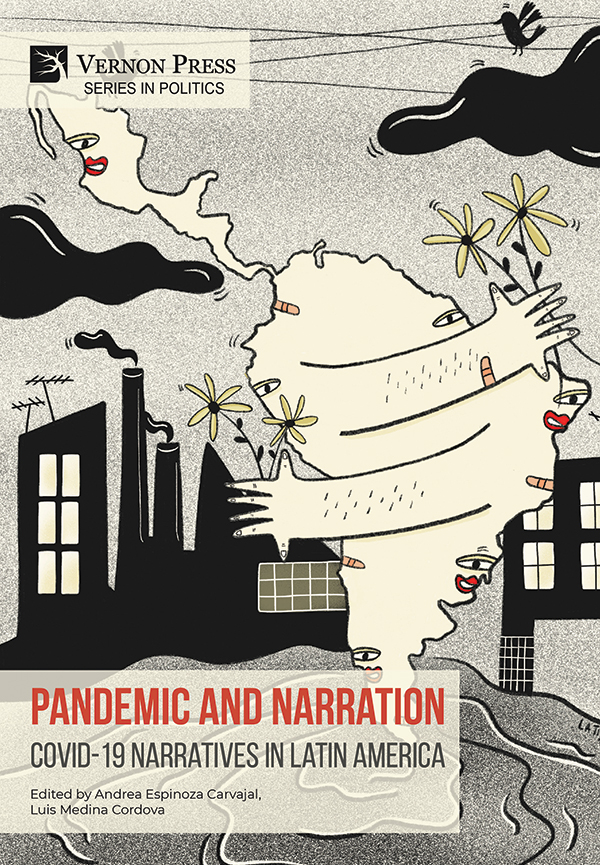
'Pandemic and Narration: Covid-19 Narratives in Latin America' sheds light on how, as Covid-19 spread, infecting and killing millions across the world, life not only continued to be experienced but also continued to be narrated. By putting together this volume, we help understand what happened in the region from a perspective in which, unlike most of what we saw during the health emergency, numbers, statistics and percentages are not at the centre of the analysis. The essays gathered here foreground something else: the manifold ways Covid-19 was subjectively and collectively narrated in the news, government reports, political speeches, NGO communications, social media, literature, songs and many other media. From a wide range of disciplinary approaches, the contributors to this edition pay attention to how fictional and non-fictional stories, official discourses, as well as personal and political accounts, documented, represented and shaped the health crisis, laying bare how —in Latin American countries— the spread of the virus intersected with corruption, gender-based violence, inequality and exclusion, as with community, solidarity and hope. Readers will find that the focus on narrative provides an alternative source of knowledge on Latin America’s Covid-19 experience. Our perspective contrasts with the usual emphasis on death tolls, infection rates, weekly cases, vaccination counts, and the plethora of statistics that illustrated the gravity of the situation in the build-up to, during, and after the peak of the crisis. While extremely important to understand the situation, numbers do not tell the whole story. A comprehensive picture of the pandemic can only be achieved when the stories of the virus are accounted for. Health, after all, is no stranger to narrative. And neither is Latin America.
By: Susan Keith, Carole Salmon, Gruia Badescu, John Sampson, Angélica Lozano-Alonso, Roderick J. Barman, Eunice Rojas, Cheryl A. Morgan, Marcelline Block, William G. Allen, Anne Quinney, and Elena Mazzoleni
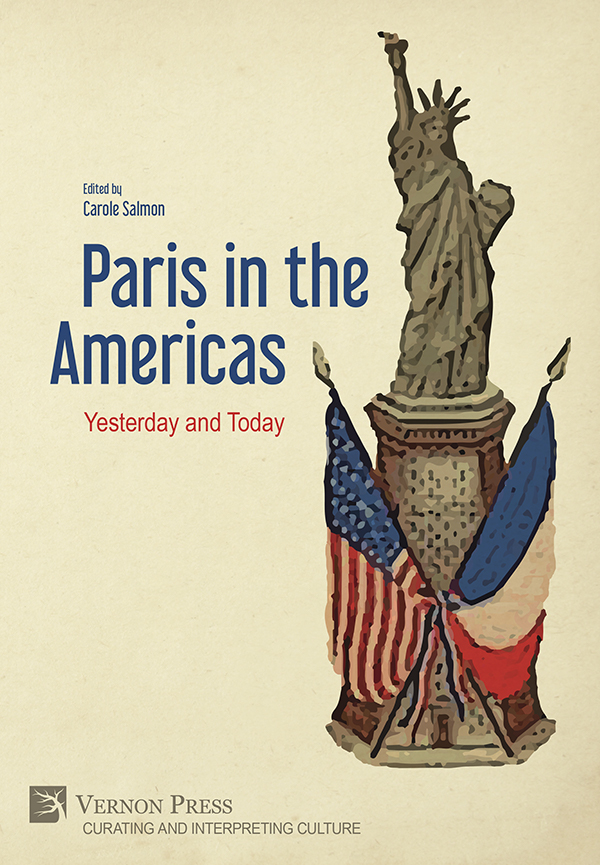
Across centuries, France -and especially its capital city, Paris- established itself as a major source of influence across the Americas through colonization, diplomacy and political influence, but also through intellectualism and cultural productions of all sorts, either by imposition, exportation or as a trend of fashion via a bilateral transatlantic movement of people and ideas. In itself, the influence of Paris, the “capital of the world,” as Patrice Higonnet (2002) analyzes it, is similar to a phantasmagoria, which results in a transatlantic fascination for the city of lights and all the tangible or intangible elements that function as its embodiment. As Stuart Hall explains, understanding cultures and languages and their representations through various manifestations presupposes that we can identify, understand and interpret the signs that constitute their core identity. (Hall 2013). In an interdisciplinary approach, this multi-authored, edited volume examines the long-established relationships between Paris and cities across the American continent, in the past as well as in the present time. In order to explore all aspects of Paris’s influence(s) in the Americas, this volume is organized around two main axes of analysis: first, in a geographical progression from North to South, the reader is invited to reflect upon cultural productions that demonstrate the many influences of Paris in the Americas through theater, literature, philosophy, fashion and cinema (chapters 1 to 6). In the following chapters (7 to 11), the volume focuses particularly on a variety of urban connections that take the reader from South to North this time, analyzing tangible architectural and urban design influences of Paris in major cities such as Rio de Janeiro, Buenos Aires, Mexico City, New York, or Washington D.C. In today’s global world, this multifaceted study of Paris’ visible and invisible influences in the Americas clearly reveals the transnational intersections of spaces, languages, people and cultures.