Loading...
Please wait while we load the content...

Loading...
Please wait while we load the content...
Loading...
Please wait while we load the content...
Explore peer-reviewed titles across the humanities and social sciences - rigorous research, fresh perspectives, and scholarship that inspires dialogue across disciplines.
Stay informed about our latest publications, calls for proposals, author news, events, and special announcements.
Join our community of scholars, librarians, authors, and readers and receive the latest updates from Vernon Press directly in your inbox.
From special discounts and global distribution partners to downloadable catalogs, flyers, and high-resolution covers, we make it easy to enrich your library’s collection. Access bibliographic data, explore subject-specific listings, and stay updated on forthcoming titles.
Become part of our librarian network and access dedicated tools, discounts, and resources to support collection development and promote new titles to your patrons.

Partner with Vernon Press to provide your customers with high-quality, peer-reviewed scholarship. We offer flexible ordering options, reseller agreements, and promotional materials to support your sales and outreach.

Vernon Press provides dedicated resources to help instructors adopt our books for courses and to support students with affordable access to high-quality scholarship. From desk and examination copies to tailored student editions, we aim to make our titles accessible in the classroom.

At the University Level
Edited by: Alberto Regagliolo (UKSW University)
No description available
Radical Eco Art in Action. Volume I
By: Cara Judea Alhadeff (European Graduate School)
No description available
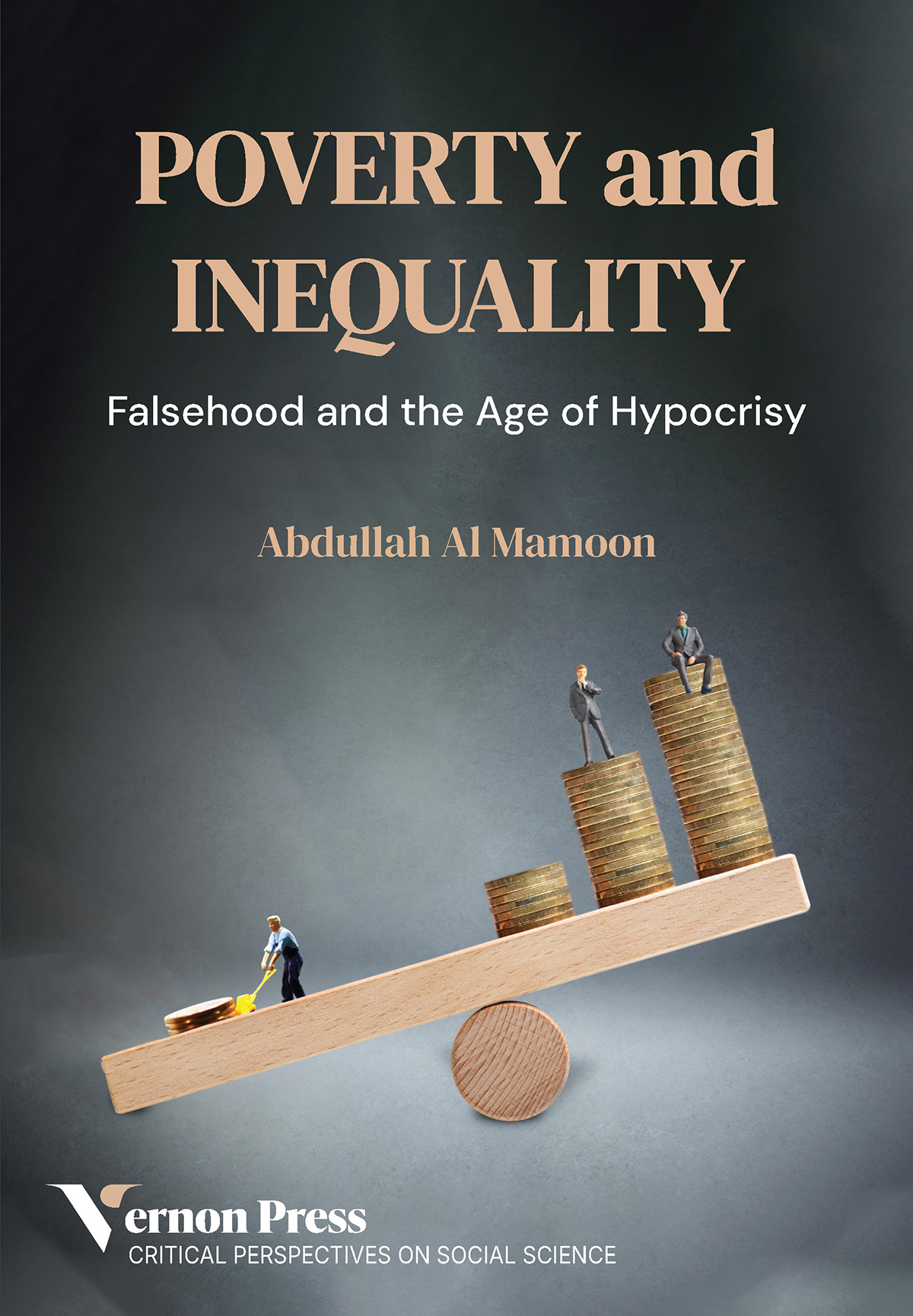
Falsehood and the Age of Hypocrisy
By: Abdullah Al Mamoon (Leeds Business School, Leeds Beckett University)
'Poverty and Inequality: Falsehood and the Age of Hypocrisy' offers a sustained critique of global capitalism and the ideological structures that reproduce and normalise inequality. It advances the argument that contemporary poverty, in a context of unprecedented global wealth, is not an accidental outcome but a systematically produced condition sustained through institutional arrangements, political economy, and entrenched narratives of legitimacy. Engaging critically with Amartya Sen’s Capability Approach and Antonio Gramsci’s theory of hegemony, the book develops an original analytical framework—the Hegemonic Capability Framework (HCF). This model integrates material, institutional, and epistemic dimensions of inequality to explain how deprivation is reproduced not only through economic relations but also through cultural consent, knowledge production, and ideological capture. In doing so, it extends existing debates in political economy, development studies, and political theory by offering a unified account of how domination operates across structural and symbolic domains. Empirically informed and theoretically grounded, the work combines data-driven analysis with normative political philosophy to interrogate the moral and institutional foundations of global inequality. It situates itself within critical traditions in global governance and social theory while proposing an original conceptual apparatus for analysing power and deprivation. The book will be relevant to scholars in political economy, sociology, development studies, and global governance, as well as to policymakers, researchers, and practitioners in international organisations, think tanks, and non-governmental institutions. It is suitable for advanced undergraduate and postgraduate teaching, and functions both as a critical reference text and as a conceptual tool for analysing inequality, capability deprivation, and structural reform in contemporary global systems.
Primary and Secondary Education
Edited by: Alberto Regagliolo (UKSW University)
'Broadening Horizons in Classics: Primary and Secondary Education' examines the teaching of classical languages and cultures in contemporary educational contexts. It addresses the challenges that the Classics face within modern curricula while showing how new pedagogical approaches continue to sustain and renew the field. The volume includes thirteen chapters written by teachers and researchers working in different educational contexts. The contributions discuss topics such as the place of the Classics in current educational systems, the use of digital tools in the classroom, communicative and student-centred approaches to Latin and Ancient Greek, the use of authentic texts and ancient commentaries, and comparative and intercultural perspectives. Several chapters also present classroom practices developed in schools, offering examples of activities and projects aimed at engaging students with the classical world. Through the integration of research, methodological reflection, and teaching practice, the volume provides a resource for educators and scholars engaged in the development and renewal of classical languages and cultures in primary and secondary education.
Russia's War Against Ukraine and the Forgotten Future
By: Nataliya Shpylova-Saeed (Harvard Univeristy)
How did narratives denying Ukraine’s sovereignty and distinct identity become normalized within Russian society? How did the war against Ukraine come to be viewed as legitimate and even necessary by many in Russia? And what role has memory played in shaping Russia’s aggression against Ukraine? This book examines how Russia’s mnemonic practices contributed to the normalization of war against Ukraine and to efforts aimed at erasing Ukrainian identity in territories currently occupied by Russia. The Kremlin has spent more than two decades encouraging and strengthening a mnemonic system that glorifies the Russian Empire and the Soviet Union, cultivates narratives of national greatness, and combines a sense of historical victimhood with claims of strength, resilience, and invincibility. Drawing on presidential New Year addresses, televised entertainment programs, commemorative concerts, educational initiatives, and policies implemented first in Russia and later extended to Ukrainian territories, the book shows how memory became a strategic instrument of war, used not only to justify territorial expansion but also to challenge the very existence of Ukraine as an independent political and cultural community. Complementing scholarship on propaganda, the book broadens the discussion and examines the deeper mnemonic and cultural foundations that helped normalize Russia’s war against Ukraine. Rather than viewing public support for the war solely as the product of state propaganda, it explores how political rhetoric, popular culture, education, and commemorative practices strengthen a broader worldview rooted in imperial nostalgia, national exceptionalism, and historical entitlement. The concepts of mnemonic abuse and memoricide reveal the progression from memory manipulation within Russia to attempts to erase Ukrainian identity in territories occupied by Russia since 2014, including Crimea, Donetsk, and Luhansk, as well as regions seized after 2022. The analysis further develops the distinction between Russia’s uncontested memory and Ukraine’s contested memory. While Russia’s uncontested memory helps explain its persistent inability to recognize Ukraine as a distinct nation, Ukraine’s contested memory provides insight into the Ukrainians’ resistance to Russian domination. By combining analyses of political rhetoric, popular culture, and occupation policies, this book invites readers to examine Russia’s war against Ukraine as a war against the memory, identity, and existence of the Ukrainian nation. It will be of interest to scholars and students of memory studies, Ukrainian and Russian studies, media and propaganda studies, postcolonial studies, genocide studies, and Eastern European history.
Communication, culture, and the mid-career crisis
By: Laura Nicole Miller (Assumption University Grenon School of Business) and Karen McCullough (Fort Hays State University)
No description available
Psychoanalytic Approaches to 21st Century Fiction and Film
Edited by: Ercan Gürova (Ankara University, Turkey)
‘Psychoanalyzing the Post-Apocalypse: Psychoanalytic Approaches to 21st Century Fiction and Film’ offers an interdisciplinary exploration of contemporary post-apocalyptic literature and cinema through psychoanalytic theory. Bringing together studies of major novels, films, and television series, the volume demonstrates how Freudian, Lacanian, Jungian, and post-Lacanian perspectives illuminate recurring themes such as trauma, desire, mourning, identity, repression, survival, and psychic renewal in worlds shaped by catastrophe. The collection distinguishes itself by applying diverse psychoanalytic frameworks to a broad range of twenty-first-century texts, including "Oryx and Crake," "The Stone Gods," "Station Eleven," "War of the Worlds," "Vesper," "The Road," "The Leftovers," and "2012". Rather than offering generalized discussions of apocalypse, each chapter provides a theoretically grounded analysis of a specific work, revealing how narratives of collapse reflect contemporary anxieties while also imagining new forms of subjectivity, ethical relations, and resilience. Positioned at the intersection of psychoanalytic criticism, literary studies, film studies, and cultural theory, the volume advances current scholarship by foregrounding the psychological dimensions of post-apocalyptic storytelling and demonstrating the versatility of psychoanalytic approaches in interpreting ecological, technological, and existential crises. It contributes an original perspective to the growing body of research on post-apocalyptic fiction by integrating multiple psychoanalytic traditions across diverse media and cultural contexts. The book will serve as a valuable resource for researchers, graduate students, and advanced undergraduates in literature, film, media, psychoanalysis, and cultural studies. It is equally suitable for classroom adoption in courses on contemporary fiction, speculative literature, adaptation, and critical theory, while offering scholars a methodological framework for future interdisciplinary research on apocalypse and the human psyche.
Edited by: Marina Cuzovic-Severn (California State University)
This volume examines representations of resilience in Spanish literature and cinema from medieval Iberia to the present. Bringing together interdisciplinary perspectives, the collection explores how individuals and communities respond to political, social, and economic crises across a range of cultural texts. Organized into four thematic sections—contemporary social issues in cinema, historical memory and trauma, gender and women’s resilience, and reimagining Spanish identity—the volume addresses topics such as the refugee crisis, rural transformation, Francoism, motherhood, and Spain’s colonial legacy. Through these case studies, the contributors analyze the strategies of adaptation, resistance, and survival that shape cultural production in times of crisis. By situating resilience within broader historical and cultural contexts, this volume contributes to ongoing scholarship in cultural studies while offering a nuanced understanding of how Spanish literature and cinema engage with collective and individual forms of adversity. It is a valuable resource for scholars and students interested in the intersections of culture, history, and social change.
Perspectivas críticas desde América Latina
Edited by: Guillermo A. Luppi (Universidad de La Serena, Chile)
'Música antigua: Perspectivas críticas desde América Latina' ofrece, hasta donde sabemos, la primera reevaluación colectiva y sostenida de la música antigua desde perspectivas latinoamericanas. En lugar de considerar la música antigua como un repertorio estable definido por la periodización europea o por el movimiento de interpretación históricamente informada, el volumen la aborda como un campo dinámico y en disputa, en el que los cánones, los archivos, las pedagogías, las prácticas interpretativas y los relatos historiográficos se negocian continuamente. Reuniendo a especialistas de diversos contextos académicos latinoamericanos e iberoamericanos, el libro examina una amplia gama de temas: la enseñanza de la historia de la música en la región; la arqueomusicología andina; la conciencia histórica y la pedagogía de la música antigua; el impacto de la Leyenda Negra española en la historiografía musical; el canto llano en Hispanoamérica; el villancico religioso en la Hispanoamérica colonial mediante análisis de macrodatos ('big data'); los 'villancicos de negro' de Puebla; las instituciones de música antigua en Brasil; y las políticas de la autenticidad en los archivos de música misional de Bolivia. A través de estos estudios de caso, el volumen aborda cuestiones más amplias relacionadas con la colonialidad, la formación de cánones, la autoridad archivística, la agencia de los pueblos indígenas y afrodescendientes, la memoria cultural y la circulación del conocimiento musical. Enmarcado por un prólogo de Leonardo Waisman y un epílogo de Miriam Escudero, el volumen incluye siete capítulos en español y dos en portugués, lo que refleja el carácter multilingüe de la musicología latinoamericana e iberoamericana. El libro contribuye a los debates actuales en musicología, etnomusicología, estudios de la interpretación, estudios latinoamericanos e historia cultural al cuestionar los marcos heredados del Atlántico Norte y proponer formas de estudio de la música antigua más arraigadas en las realidades regionales. Será una obra de referencia útil para investigadores, una herramienta metodológica para especialistas que trabajan en historia e historiografía de la música, y un recurso docente para cursos de grado y posgrado sobre música antigua, música latinoamericana, música colonial, historiografía musical y enfoques decoloniales de las artes. Aunque posee un sólido rigor académico, el volumen también resulta relevante para intérpretes, docentes y directores de conjuntos musicales que buscan perspectivas críticas sobre la música antigua más allá del canon europeo tradicional.