Loading...
Please wait while we load the content...

Loading...
Please wait while we load the content...
University of Oulu, Finland

By: Jukka Kortti, Heidi Kurvinen, Tiina Kinnunen, Heikki Kokko, Markku Mattila, Ari Haasio, Karin Jonsson, Arja Turunen, Hannah Yoken, and Birgitte Kjos Fonn
Ideologies have not been a focus of interest in the field of humanities and social sciences in recent decades, but rethinking the power of ideologies in the media sphere has recently returned to the scholarly discussion. The compilation book “Mediated Ideologies: Nordic Views on the History of the Press and Media Cultures” participates in this by providing selected yet justified approaches to media history from the point of view of ideological uses of media in the Nordic region. In this book, the role of media – comprising both popular media and news journalism – as a forum for ideologies and their circulation will be analyzed by focusing on the Nordic region. The perceived similarities in the media systems of the Nordic countries constitute a perfect extent for a regional media history against not only a European but also a global backdrop. This does not mean that there have not been many national differences. The book does not provide a chronological narrative of Nordic media history. Still, the ideology of media is approached not only from the standpoints of different media forms – film, television, newspapers, magazines, and periodicals – but also from several historical periods from the mid-19th century to the late 20th century. The chapters show the multidimensional role that the media has in transmitting ideologies to their audiences and the public sphere. They also demonstrate that analyzing the role of different ideologies, such as modernization, nationalism, solidarity, feminism, and peace movement in media history provides wider perspectives in understanding past and present media landscapes and people’s mediated experiences that are fostered by them. “Mediated Ideologies: Nordic Views on the History of the Press and Media Cultures” can be used both as a reference book and as a classroom adaption in the field of media, communication, and history studies.
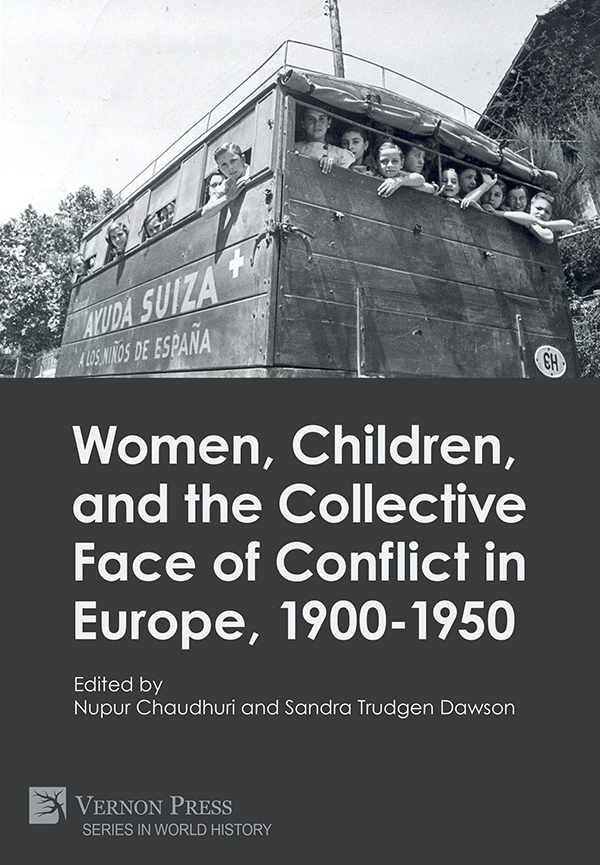
By: Mary Laurents, Tiina Kinnunen, Marianne Junila, Kenneth Mouré, Suzanne Dunai, Mark J. Crowley, Gina Benavidez, Patrick José Dawson, Michelle Tusan, Allison Scardino Belzer, Andrew Orr, Laurie S. Stoff, and Sandra Trudgen Dawson
Europe was in turmoil during the first half of the twentieth century. The political stability that emanated from nineteenth-century political liberalism began to break down, reaching climaxes in the Great War, the Spanish Civil War, and the Second World War. Revolutions in Russia and Spain threatened parliamentary governments, and the Armenian genocide that began in 1915 foreshadowed the systematic destruction of European Jews in the 1930s and 1940s. Dictators seized power and established authoritarian regimes that stymied democratic expression and censored the press. Much of the scholarship on each of the conflicts has tended to focus on the military (male) and the civilian (female) binary. Women and children experienced every conflict during this tumultuous period as civilians, consumers, victims, exiles, and combatants. As histories of women and war suggest, there are exciting new areas of research and scholarship that resist simplistic binaries. Women were not simply civilians or victims. They were actors in the minutiae of wars, revolutions, dictatorships, and genocides. Children were present in these conflicts and not invisible, as many histories suggest. They too were actors and often politicized by propagandist literature and sectarian education through their own experiences and the politics of their families. This collection seeks to complicate the child/ adult distinction and examine the experiences of women and children as lenses to view a more collective face of conflict. While the volume brings to attention conflicts in Europe, the editors acknowledge the global ramifications of the revolutions, wars, and genocides, as well as the multitude of individual experiences. This collection seeks to expand understanding of the personal as the political in European conflicts from 1900-1950. We believe the focus on women and children offers a diverse perspective on five tumultuous decades of European history.