Loading...
Please wait while we load the content...

Loading...
Please wait while we load the content...
Endicott College; University of Oregon

By: Cássia Leal da Hora, Ellie Kazemi, Sarah Kern, Grace Ecko Jojo, Samantha LaPointe, T. V. Joe Layng, Amy Odum, Joseph Pear, D. Perez, Kenneth F. Reeve, Christen E. Russell, Brian Saville, Ana Carolina Sella, Noor Syed, April Michele Williams, Kendra Guinness, Daniel M. Fienup, Frances M. Falzarano, Natalie M. Driscoll, Christopher R. Colasurdo, Philip N. Chase, Videsha Marya, Mary Jane Weiss, Lisa Tereshko, Darlene E. Crone-Todd, Nicole Gravina, Andresa A. De Souza, Alicia M. Alvero, Kimberly B. Marshall, and Andressa Sleiman
This cutting edge, timely book is a primary resource for students, faculty, coordinators, and supervisors in the growing field of behavior analysis. This book acts as a single resource that pulls together the background, current status, and future directions related to the relevance of a behavior analytic approach to teaching, assessment, and supervision. The authors collaborating in this volume are experts at various stages of career development and have a known presence in the field. This combination of theory driven, and high-caliber authors have collaborated to create a one-of-a-kind book drawing from backgrounds of diversity in terms of gender, areas of expertise, and geography. The recent pandemic has resulted in a pivot to remote learning and online supervision; this text will provide an important contribution in terms of understanding how to provide high quality teaching, supervision, and assessment in behavior analysis and among other areas. As the field is moving to increasing standards for programs that correspond to accreditation body standards, this book also provides timely information about how to prepare for this process including cultural competency and ethics, which guide our teaching and practice.
By: Joseph H. Cihon, Kimberly B. Marshall, Agustin Jimenez, Kristin Bowman, Michelle Walker, Pauline J. Horne, Mitch Fryling, Keith E. Williams, Jonathan W. Ivy, Aaron J. Fischer, Lauren E. Martone, Heather Lewis, Hunter C. King, Meeta R. Patel, Nicholas Orland, Amy E. Tanner, Lisa Tereshko, Mary Jane Weiss, Laura Seiverling, Elise Jusko, JoKathleen Rodriguez, Anselma Kuljanic, Bill Weaver, Sean D. Casey, Meara X. H. McMahon, Gregory K. Reed, and Videsha Marya
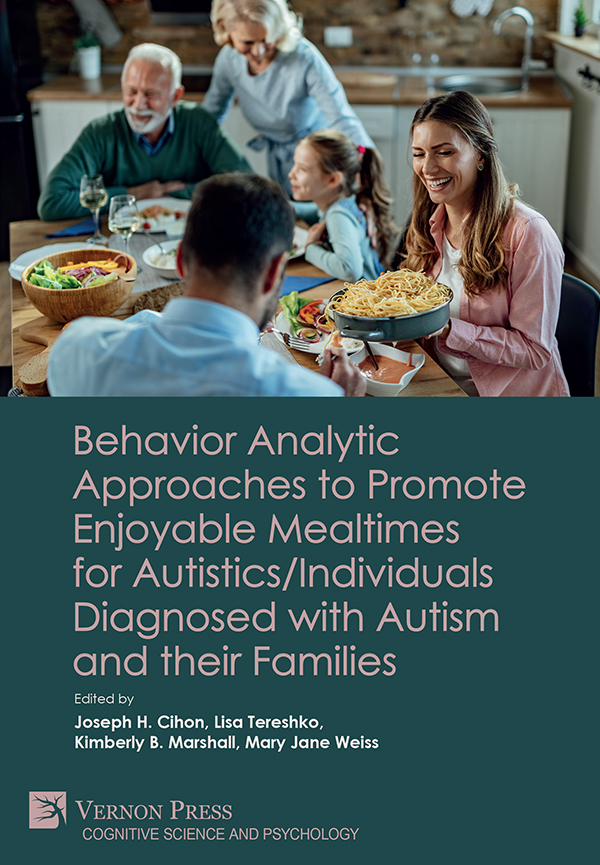
It has been estimated that 70% to 90% of individuals diagnosed with autism spectrum disorder (ASD) experience mealtime challenges (Volkert & Vaz, 2010). Most approaches to the treatment of mealtime challenges have focused on decreasing interfering mealtime behaviors through escape extinction (i.e., requiring consumption of food prior to meal termination) and other approaches that may be perceived as punitive by parents, individuals diagnosed with ASD, and other stakeholders. In recent years, there has been an increase in research on promoting enjoyable mealtimes for individuals diagnosed with ASD and their families. The purpose of this edited book is to provide a comprehensive review of these approaches for improving mealtime behaviors for individuals diagnosed with ASD, provide clinical recommendations for improving mealtime behaviors, and identify areas for future research.