Browse by Subject
Explore our complete collection
Status
Format
Language
Publishing
Resources
News & Updates
About Vernon Press
Subjects
Series
Publication Status
Type
Loading...
Please wait while we load the content...
Budapest Business School, University of Applied Sciences, Hungary
By: Yliana V. Rodríguez, Rita Kóris, An Slootmaekers, Mădălina Chitez, Loredana Bercuci, Emma Abbate, Jolana Tluková, Katherine Guertler, Lucía López Risso, Eric Koenig, Christian Rubio, Viktória Lázár, Klára Bereczky, Salomi Papadima–Sophocleous, Elis Kakoulli Constantinou, Dita Gálová, and Martina Vranova
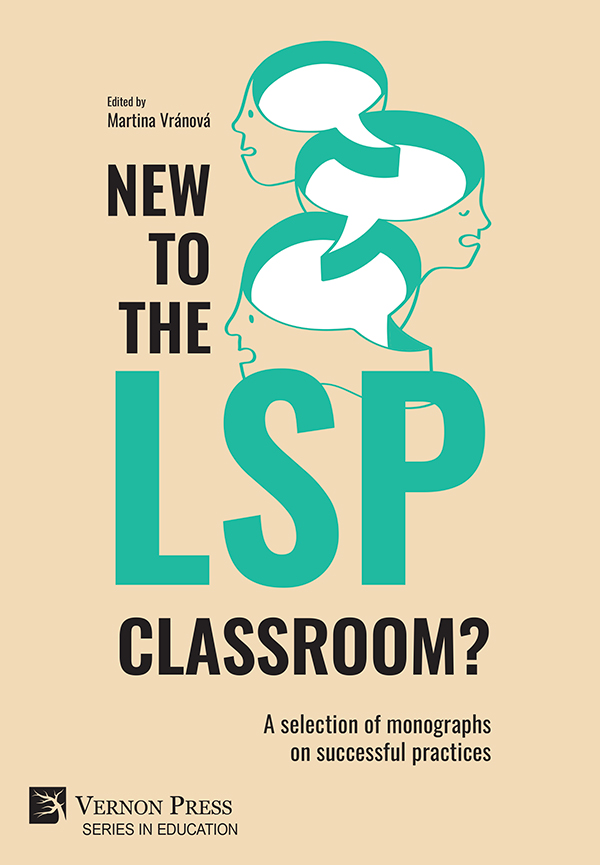
As Languages for Specific Purposes have always been defined as student-oriented, the rationale behind this volume is to use the rather neglected niche of the other necessary agent of language instruction and thus focus on the LSP practitioner. This turn towards the instructor has been motivated by the fact that a great number of LSP practitioners enter their jobs without previous expertise. They lack LSP education, or they may not even have a background in applied linguistics. This motivation has proven valid as many of the volume’s contributors have faced this particular situation in their professional lives. For insights into the LSP field and guidelines on the best practices, they must rely on their colleagues who offer to share their experience through workshops, conferences, or papers, which is what this volume provides. The primary goal of this volume is to present considerations of what challenges LSP practitioners face and should be prepared for in their jobs and to provide practice-tested methodological guidelines on such demanding teaching techniques as blended and flipped learning or tandem learning. All papers have been written by LSP practitioners and researchers in higher education. Thus, this volume provides both guidance and self-reflection. In other words, it is written by experienced LSP practitioners for aspiring LSP practitioners about how they see themselves and what effort they make to meet the challenges of their jobs. As proof that LSP practice is a global challenge, papers have been collected from many European countries, the USA, Uruguay. Even though most papers are naturally concerned with English, being the lingua franca of today, the collection also features guidelines for teaching Spanish, French and Dutch for specific purposes. Moreover, the target disciplines these languages are taught for encompass business, engineering, sociology or medicine, thus supporting the assumption of the universal character of problems LSP practitioners deal with.