Loading...
Please wait while we load the content...

Loading...
Please wait while we load the content...
Stay informed about our latest publications, calls for proposals, author news, events, and special announcements.
Join our community of scholars, librarians, authors, and readers and receive the latest updates from Vernon Press directly in your inbox.


Availability
Available through resellers
ISBN
9781648892707
Edition
1
Publication Date
September 7, 2021
Physical Size
Number of Pages
371
Currency
Quantity
Prof. Grant Smith is a well-known researcher with an excellent reputation in the onomastic world. For several decades he has had an intense activity, quantified by publications in scientific journals, proceedings, participation in congresses and conferences in America, Europe, Israel, and administrative functions in top organizations such as ANS and ICOS.
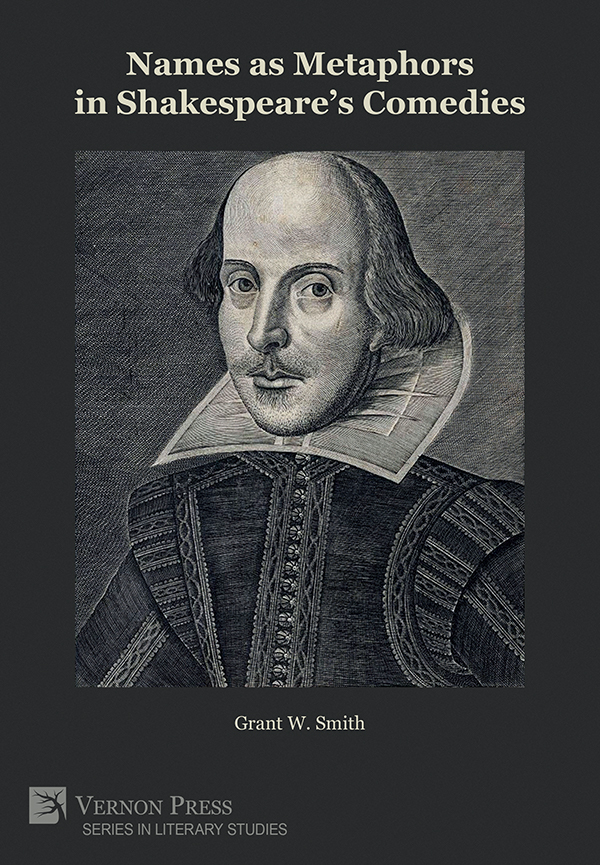
In "Names as Metaphors in Shakespeare’s Comedies", the author proposes a collection of analytical essays on Shakespeare’s fourteen comedies plus an introduction. This book offers a novel perspective on the names of characters in Shakespeare's comedies. From the author's perspective, literature is not propaganda, with arguments for ideas and policies, but an expression of basic human emotions.
With extensive experience in literary onomastics, onomastic theory, and semiotics, Professor Grant W. Smith crowns with this volume his longstanding interest in anthroponymic analysis and Shakespeare’s plays.
Dr Oliviu Felecan
Technical University Of Cluj-Napoca
North University Center Of Baia Mare, Romania
The doyen of onomastics undertakes the attempt to explain Shakespeare's names' poetic effects and analogical meanings. He succeeds by this impressive work to demonstrate the symbolic meaning of anthroponyms and proper names in general that transcends by far their formal function of designation. Besides his systematic and analytical approach towards the use and role of names in literature, he also provides a colorful insight into how a poetry champion played with name symbolism. Thus, the book covers a wide range from laying a theoretical basis for literary onomastics to better understand a great poet and his works. Onomasticians, as well as everybody interested in exploring the wealth of literature, will enormously benefit from it.
Dr Peter Jordan
Austrian Academy of Sciences, Co-chair, Joint ICA/IGU Commission on Toponymy
Discover books that expand on the themes explored in this work—titles that engage with similar questions, intersecting disciplines, and complementary perspectives to deepen understanding and broaden the conversation.
Browse all titles