Loading...
Please wait while we load the content...

Loading...
Please wait while we load the content...
Stay informed about our latest publications, calls for proposals, author news, events, and special announcements.
Join our community of scholars, librarians, authors, and readers and receive the latest updates from Vernon Press directly in your inbox.

Availability
In stock
ISBN
9781622737871
Edition
1
Publication Date
January 3, 2020
Physical Size
236mm x 160mm
Illustrations
13 B&W
Number of Pages
290
Currency
Quantity
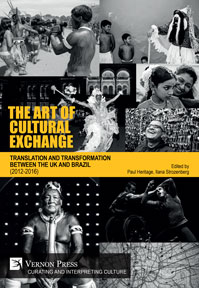
Can cultural exchange be understood as a mutual act of translation? Or are elements of a country’s cultural identity inevitably lost in the act of exchange? Brazil and Great Britain, although unlikely collaborators, have shared an artistic dialogue that can be traced back some 500 years. This publication, arising from the namesake research project funded by the United Kingdom’s Arts and Humanities Research Council, seeks to understand and raise awareness of the present practices of cultural exchange between Brazil and Great Britain in relation to their historical legacy. Presenting five case studies and eight position papers, this research-based project investigates how artists interpret, transmit and circulate ideas, ideologies and forms of knowledge with specific reference to the production of new ‘translations’ produced from and, where possible, between peripheral territories. Written in accessible language, the case studies describe the experience of artists, managers and cultural leaders dealing with important challenges in the creative sector regarding the translation of creative and learning arts methodologies. Projects investigated are at the forefront of social arts collaborative practice, representing internationally influential initiatives that have had a demonstrable impact not only in urban centres and peripheries but also in isolated areas of central Brazil and the north of England. The position papers commissioned by the research from Brazilian and British academics and cultural leaders provide a remarkable variety of social, political, anthropological, historic and artistic perspectives of cultural exchange projects offering valuable experiences for those working in research, policy and for creative practitioners.
Discover books that expand on the themes explored in this work—titles that engage with similar questions, intersecting disciplines, and complementary perspectives to deepen understanding and broaden the conversation.
Browse all titles
Lee Davidson and Leticia Pérez-Castellanos
View more
Joana Antunes, Maria de Lurdes Craveiro, and Carla Alexandra Gonçalves (Eds.)
View more