Loading...
Please wait while we load the content...

Loading...
Please wait while we load the content...
Stay informed about our latest publications, calls for proposals, author news, events, and special announcements.
Join our community of scholars, librarians, authors, and readers and receive the latest updates from Vernon Press directly in your inbox.


Availability
In stock
ISBN
9781648891007
Edition
1
Publication Date
October 6, 2020
Physical Size
236mm x 160mm
Number of Pages
274
Currency
Quantity
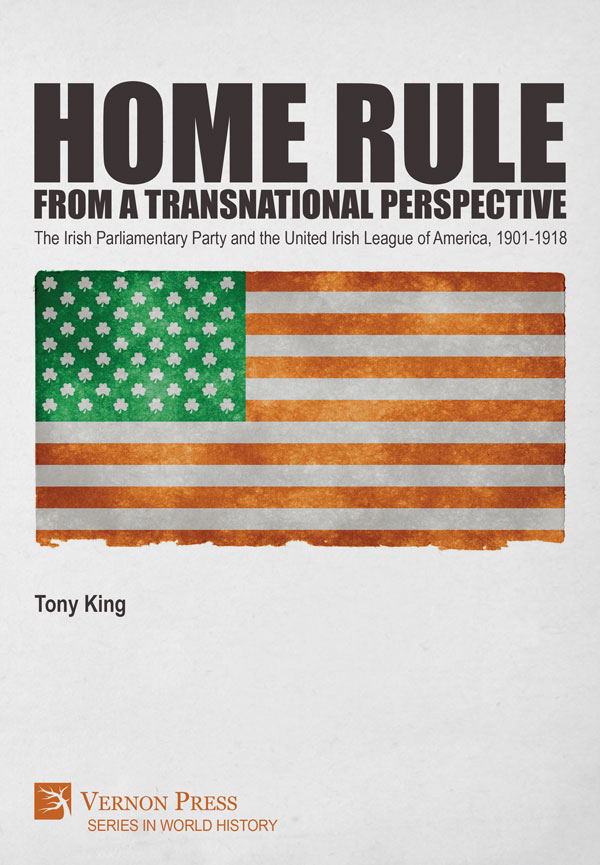
Tony King’s book is a welcome contribution to a tangled transatlantic tale. King skillfully weaves the Irish diaspora, Irish politics, and Irish-American nationalism into a compelling narrative of transatlantic connections and disjunctions. The United Irish League of America may have been overtaken by events, but as King shows, its true meaning rested in how it defined the parameters of Irish political aspirations during a volatile time of global upheaval.
Dr Patrick Griffin
Madden-Hennebry Professor of History; Director, Keough-Naughton Institute for Irish Studies
University of Notre Dame
The original angle of this meticulous study makes a significant contribution to research on John Redmond and Irish American politics. Drawing on extensive private correspondence and contemporary publications, including a little known body of United Irish League of America (UILA) publications, the author provides insights into the ideology and transatlantic operations of the organisation. The wider significance of the study lies in its contextualisation, its consideration of the UILA’s rivals and critics. It also sheds light on Irish American perceptions of and reactions to political, social and cultural developments in Ireland. The analysis of perspectives on US involvement in international events, filtered through the lens of Irish American Anglo-phobia, is of considerable interest.
This is a timely publication in light of the current focus in Ireland on the Decade of Centenaries (1913-1923). It is a welcome contribution to the historiography of Redmond and Home Rule, a field attracting increasing interest after many years of neglect. It will appeal to readers interested in Irish history; Irish American history; Irish Studies; diaspora studies; and transnational studies.
Critics may find King’s judgment on Redmond harsh in light of his challenges and may question the counterfactual comments; however, the author provides compelling arguments, justifiably drawing attention to Irish republicans’ more effective transatlantic operations.
Dr Mary N. Harris
School of Humanities
National University of Ireland, Galway
Discover books that expand on the themes explored in this work—titles that engage with similar questions, intersecting disciplines, and complementary perspectives to deepen understanding and broaden the conversation.
Browse all titles