Loading...
Please wait while we load the content...

Loading...
Please wait while we load the content...
Stay informed about our latest publications, calls for proposals, author news, events, and special announcements.
Join our community of scholars, librarians, authors, and readers and receive the latest updates from Vernon Press directly in your inbox.


Availability
In stock
ISBN
9781648891762
Edition
1
Publication Date
September 7, 2021
Physical Size
236mm x 160mm
Number of Pages
135
Currency
Quantity
The knowledge that the authors have contributed through this study is from many years of teaching biblical interpretation. [...] The teaching experience was brought to bear on the work with the review exercises at the end of each chapter. This makes the monograph an introductory book for teaching biblical interpretation in seminaries, religious departments, and Bible Schools in Ghana. The guidelines/principles outlined for the interpretation of various genres of the Bible are very helpful and appeal more to undergraduate students and pastors who are interested in biblical interpretation. [...]
The language and format of the book are easy to follow.
Dr. Daniel Nii Aboagye Aryeh
Acting Rector
Perez University College, Ghana
Isaac Boaheng and Frederick Mawusi Amevenku are to be greatly congratulated and celebrated for jointly authoring the new book – “Biblical Exegesis in African Context”. This is undoubtedly a welcome text in our African context and theological space. It is probably the first book of its type, written and published to meet the needs of students in African biblical and theological institutions. The public and specialized libraries and bookstores in sub-Saharan Africa, but particularly of African theological institutions, are populated almost exclusively by texts written by Western authors. Books by African authors are few and far between. Moreover, those that find their way here tend to be either too technical or mostly intended for devotional and popular use.
“Biblical Exegesis in African Context” has been carefully written by two outstanding, well trained, and well-informed theologians and scholars from Ghana. They are intimately acquainted with the Bible which they use both in preaching, in the course of their work as Christian ministers, and also in teaching, in the course of their role as lecturers in higher African theological institutions. The need for a proper and well-grounded understanding and interpretation of the Bible is a prerequisite for responsible preaching and enlightened teaching. Unfortunately, most people have no idea what Biblical Exegesis is, its relevance to understanding the Bible, and more so, how it is conducted.
There are clear principles and techniques for the exegesis and analysis of the Bible, allowing for an in-depth grasp of its sources and contexts, as well as an informed and well-grounded understanding of its life-giving message.
Boaheng and Amevenku’s book is an attempt to gently and simply introduce the reader to the art and science of Biblical exegesis. The book introduces the reader to the diversity and variety of existing methods of Biblical exegesis and how they can be put to use. An excellent feature of the book is the questions and exercises at the end of every chapter. While most of the methods and techniques introduced are well tried and tested over the years, especially by Western-trained scholars, some of the new and recent methods introduced in this excellent book emanate from Africa and draw upon the wealth, wisdom and spirituality of African cultures and traditions. This alone gives the book added value.
This book is highly commended and is expected to prove invaluable to the younger and upcoming generation of African theological and biblical students. No theological and biblical library in Africa can afford to deny its readers at least a copy of this timely book.
Dr. Aloo Osotsi Mojola,
Professor, Philosophy and Translation Studies, St Paul’s University, Limuru, Kenya;
Honorary Professor, Faculty of Theology, Pretoria University, Pretoria, South Africa;
Translation Consultant and former Africa Translation Coordinator, United Bible Societies
"Biblical Exegesis in African Context" is a concise and reliable introduction to Biblical exegesis. It has been written by two Ghanaian exegetes from New Testament and Old Testament studies, respectively, and it is addressed to the needs of theology students in West Africa. It engages critically Western approaches to the Bible from an informed West African cultural perspective. Nevertheless, this introduction draws on some important insights into contemporary Western hermeneutics and exegesis. While not negating the historical or diachronic dimension of Biblical writings, this introduction gives – and rightly so – prevalence to synchronic analysis, esp. making use of socio-rhetorical interpretation. The book represents an up-to-date example of African Biblical Studies, with a focus on inculturation hermeneutics and contextual exegesis. As such, it is concerned with a critical reading of the Bible that takes seriously the literary and historical contexts of Biblical writings and the cultural resources and questions of West African contexts. The new discipline of Mother-Tongue Biblical Hermeneutics, as it has been developed in Ghana, is emphasized.
This book is of particular value for the addressed context since it repeatedly discusses contemporary issues facing the church in West Africa. One such example is the question of the role of women in the church vis-à-vis Biblical passages that seem to suggest that women were inferior to men (e.g., 1Cor 14:34-35). By careful contextual exegesis, the authors are able to show the Paul’s injunction should not be universalized. Rather, ancient as well as contemporary patriarchal societies are challenged by the equalizing ethos of the Gospel. The authors identify a criterion derived from Gospel for absolutizing or relativizing a saying or position found in the Bible: a reading or theology should be “life-affirming to African communities”.
This is the first serious introduction into Biblical exegesis, written strictly from a West-African perspective. It is a well-balanced work that fills a gap in the field. It will serve the needs of theology students of any denomination in West Africa well, guiding them to a careful and methodologically sound interpretation of Biblical writings and responsible applications of Biblical values in contemporary society.
Dr. Werner Kahl
Professor, Missionsakademie
University of Hamburg, Germany
In “Biblical Interpretation in African Context”, Isaac Boaheng and Frederick Mawusi Amevenku avail themselves of a wide range of existing tools and write from a decidedly theological perspective to provide a handy and useful introductory primer to biblical interpretation, which they want to situate in broader African socio-cultural context. The layout of the book allows for it to be used either as single chapters or as a whole book, and the forthwith style in which the authors outline important hermeneutical principles and procedures for responsible biblical interpretation and its authentic use in particularly African Christians’ daily lives, will be beneficial to readers and in particular, to early-career students. Review questions, often in relation to specific biblical texts, wrap up each chapter and increase the usefulness of the book for students.
In a possible future edition(s), the authors can be encouraged to flesh out the book’s hermeneutical theory; to make closer connections between textual composition and translation and exposition; and to reflect the particularities of African context and -reading, in relation to established or conventional (read, Western) hermeneutics and exegesis.
Dr. Jeremy Punt
Professor of New Testament Studies
Stellenbosch University
Stellenbosch, South Africa
A few weeks ago, I was asked to preach at a very prominent church in Kumasi. The church was observing its Annual Cultural Celebration Sunday. Along with myself, another guest participant included was a traditional Ashanti chief, who also happened to be a Baptist Deacon and a former head of the Men’s Ministry for the Ghana Baptist Convention. He was interviewed by the pastor in front of the congregation on the topic “Can a traditional chief also be a dedicated Christian?” It was a fascinating, albeit lengthy, conversion. Of course, the Deacon/Chief answered in the affirmative, much to the delight of the clapping congregation. During the course of the conversation, the Chief sought to bolster his case by citing several biblical passages from the Old Testament and engaging in what I would deem “African Biblical Reading” or “African Biblical Exegesis” (p.59).
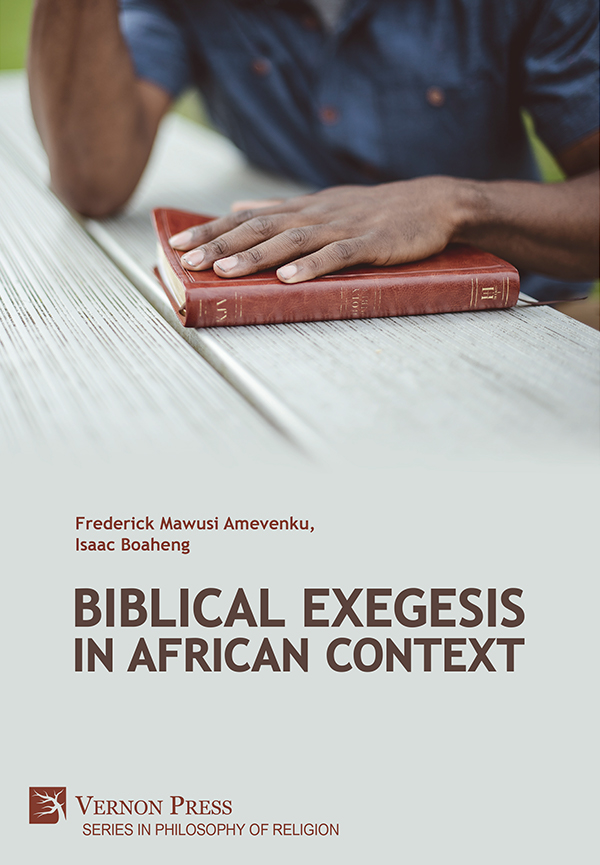
What is “African Biblical Exegesis” or “African Hermeneutics,” and how does it differ or complement what might be called “…conventional methods of exegesis based on the Western Worldview?” (p. 109). These are the questions which Frederick M. Amevenku and Isaac Boaheng seek to answer in Biblical Exegesis in African Context (Vernon Press, 2020). Written in a non-technical style which makes the text accessible to both laity and students, the authors seek to explore the topic of Biblical Hermeneutics from the vantage point of the majority world in general and Africa, specifically West Africa/Ghana in particular.
This does not mean that Historical, Grammatical, Contextual and Evangelical hermeneutics is jettisoned. To the contrary, the first five chapters of the book are an explanation and application of the hermeneutics which characterised the ancient Antiochian School, Protestant Reformers, and modern Evangelicals who brought the Gospel to Africa via the “third opportunity” wave of mission activity. This approach seeks to ascertain the authorial intent of the text as originally written. The authors recognised the difficulty of this task (p. 22) yet provide context clues to help the Bible reader do the detective work necessary to arrive at informed thoughtful conclusions regarding both meaning and significance in order to make life-changing application of the text. This is a standard fair Evangelical approach to biblical interpretation. The authors did a great job of summarising this methodology.
The chapter dealing with “Socio-Rhetorical Biblical Interpretation,” I found more interesting. Vernon Robbins, the father and systematiser of this approach, worked out his method as a connection and alternative to the widespread “dissatisfaction with form and redaction criticisms” (p.45). The authors describe this approach as “combining” people’s ways of communication with their way of life by making use of data from various fields such as linguistics (inner texture), literary comparative (intertexture), social and historical (social and cultural texture), the ideology of the text (ideological texture) and the theology of the text regarding God and human (theological/sacred texture) (p. 43).
This approach has the promise of being much more fruitful in unlocking nuances and opening up meaning not accessible to the inductive approach of popular Evangelical methods limited strictly to the context is the text itself. However, as the authors point out, this method reflects yet another Western-orientated hermeneutics, albeit its increasing popularity demonstrates a growing dissatisfaction among Postmodern Evangelicals with the status quo.
Next comes the section which, for me, creates the most interest in reading this text. African Biblical Studies (ABS) is defined as “the study of the Bible from an African perspective” (p.57). This approach to reading the text of Scripture seeks to address various issues confronting modern African society and apply the message of the Bible directly to the context. This approach is set in juxtaposition to the ways in which Africans were taught to read the Bible by the missionaries who came from the West, bringing with them certain presuppositions and priorities that would, for the most part, have failed to find cache with the continent as a whole. Advocates of ABS, both insiders and outsiders, see a greater affinity between the worldviews of the biblical characters and traditional African Societies (both past and present) than that of the Western missionaries who brought the Bible to the continent. Why should Western readings of texts be preferred or privileged over those of Africans, whether scholars and laity? In the view of the authors, they should not.
I certainly agree with the authors at this point. But I have to question whether or not it is possible, much less desirable to escape or jettison one’s cultural frame of reference to begin with. In other words, I read the text of Scripture as a white, well-educated, relatively wealthy (by world standards), Evangelical male. I have to be intentional to do otherwise. This is certainly possible and desirable and is a large part of why I am a student in a West African Seminary. Similarly, I do not see how an African can read the Bible in any way other than as an African. Perhaps what we are discussing here is more of a matter of intentionality than anything else.
I find the work of Elizabeth Mburu very helpful. She proposes a four-legged stool as an image of the four stages of doing hermeneutics from an African perspective; this involves reading the text of Scripture with sensitivity to the African worldview, keeping in mind that the Biblical worldview must take priority if there is a conflict. Next, theological concerns are addressed as secondary reflections of the primary text. I would add to this question of ethics. Mburu seems to be saying that upon reading the text, the reader will move to such questions as “What does this tell us about the nature and/or character of God? What is he like, and what does he expect of me in light of this passage?” It is only after these types of questions are addressed that issues of literary contexts or genres reflected upon. Lastly, the traditional questions of authorial intent, historical circumstances, and cultural context are considered. All of this drives the reader to the application of the text to issues in the life of the reader and her community, which Mburu images as the seat of the stools.
I find this discussion helpful. It is similar to what is typically referred to as a ready-response hermeneutic. The authority is shifted from an author and/or text-oriented reading to a reader-oriented hermeneutic. I feel that, whether you are an African or an ‘Obroni,’ this is the most common way of reding the Bible. A new Christian picks up a Bible, begins to try to understand the text in light of his/her cultural worldview, begins to ask him/herself if he/she needs to jettison or “repent” of certain mindsets in light of what she is discovering about God, humankind, sin, Jesus et. al. and only later does she discover that the Bible contains many different types of literature which was addressed to different audiences, by various authors, under different cultural settings and Hebrew and Greek.
So, I think that what Mburu is describing is not unique to Africans. And with the increasing modernisation of African culture, and expanding technological and educational opportunities, the distinctions between the global West and South may be disappearing or at least combining to create fresh new understandings for people everywhere. I certainly hope the long-held hegemony of the West is disappearing, especially in the area of Bible reading and interpretation.
I found the discussion of “mother-tongue” hermeneutics interesting. The difficulty here lies in the quantity and quality of trained scholars needed to make such a project, albeit a worthy one, become a reality. Perhaps we need to take a long view and work toward generational and incremental change and development in this worthy project. […]
Dr.Scott Camp
Evangelist, Author, Educator
Ghana, West Africa
www.scottcamp.org
Discover books that expand on the themes explored in this work—titles that engage with similar questions, intersecting disciplines, and complementary perspectives to deepen understanding and broaden the conversation.
Browse all titles