Loading...
Please wait while we load the content...

Loading...
Please wait while we load the content...
Stay informed about our latest publications, calls for proposals, author news, events, and special announcements.
Join our community of scholars, librarians, authors, and readers and receive the latest updates from Vernon Press directly in your inbox.


Availability
In stock
ISBN
9781648894084
Edition
1
Publication Date
July 12, 2022
Physical Size
236mm x 160mm
Illustrations
4 B&W
Number of Pages
140
Currency
Quantity
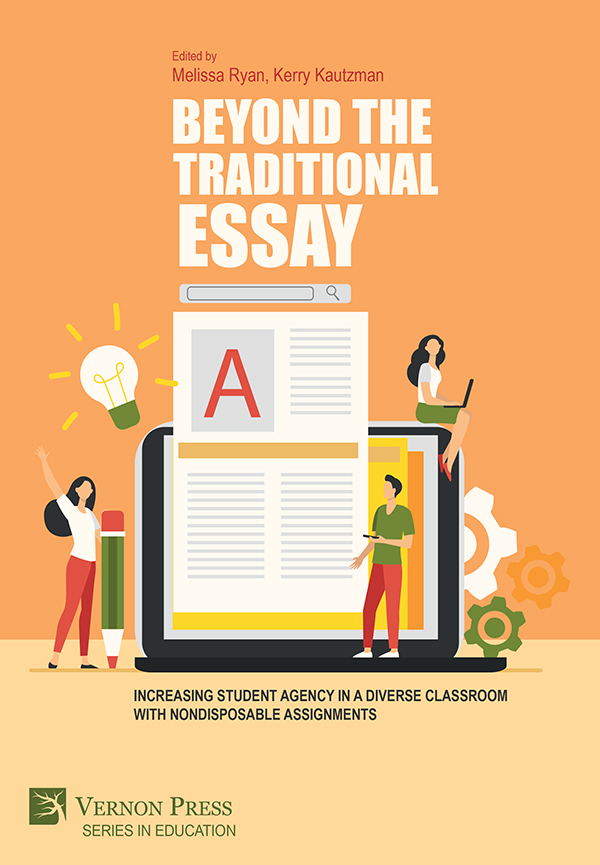
Melissa Ryan and Kerry Kautzman’s book “Beyond the Traditional Essay: Increasing Student Agency and Engagement with Non Disposable Assignment” is a must-read for educators looking to join the movement towards making higher education more inclusive, accessible, meaningful and engaging. From community-engaged learning to open educational resources, these new pedagogies are seeking to break down the classroom walls. They aim to bridge many students' experience between what they learn in their classes and “the real world.” Another important goal of these exciting pedagogies is to make higher education curricula more accessible to the public at large and non-traditional students, because decolonizing the classroom setting is a central part of their vision. The essays included in this volume focus on transforming traditional assessment tools (such as essays and exams) into inspiring projects using enhanced technologies of communication and expression. The contributors show how transformative assignments foster inclusive pedagogies that engage students with the liberal arts and make higher education accessible and meaningful beyond the classroom. The introduction teaches about key concepts from the open pedagogy movement, social justice pedagogy, and universal design learning that inform innovative non-disposable assignments. In the chapters that follow, the contributors discuss a variety of approaches, project designs and resources that involve podcasts, web resources, international collaborations, and assessment tools. The collaborative nature of the pedagogies described in this book fosters deep learning and promotes an ethics of interdependence. This book will inspire scholars, teachers, graduate students in education, literature, and other liberal arts disciplines, as well as administrators seeking to improve student engagement, agency, and pedagogical best practices.
Ariana Huberman
Spanish Department
Latin American, Iberian, and Latinx Studies (LAILS) Concentration Coordinator
Haverford College
Discover books that expand on the themes explored in this work—titles that engage with similar questions, intersecting disciplines, and complementary perspectives to deepen understanding and broaden the conversation.
Browse all titles