Loading...
Please wait while we load the content...

Loading...
Please wait while we load the content...
Stay informed about our latest publications, calls for proposals, author news, events, and special announcements.
Join our community of scholars, librarians, authors, and readers and receive the latest updates from Vernon Press directly in your inbox.


Availability
In stock
ISBN
9798881900243
Edition
1
Publication Date
September 3, 2024
Physical Size
236mm x 160mm
Illustrations
7 B&W
Number of Pages
132
Currency
Quantity
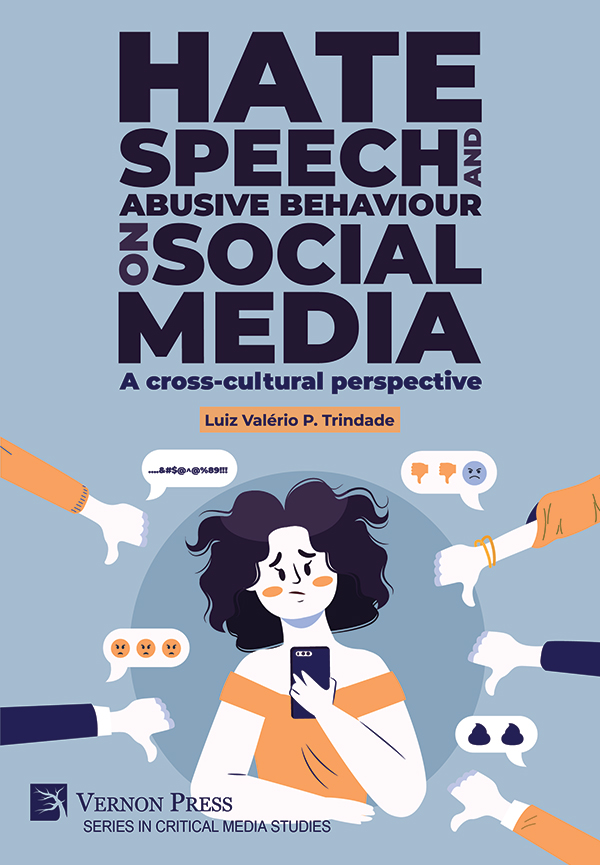
Luiz Valério’s contributions are important as a complaint against the systemic spread of hate on social media. A hatred that, in contemporary times, becomes a model of technical management responsible for suggesting the modern and colonial logics of hierarchization and precariousness of subjects announced at a distance from normative systems. In light of anti-colonial and anti-discriminatory perspectives, Luiz Valério’s theses confront the ritualization of violence taking place on networks and screens, as a manifestation of the modern pillory. In this scene, the screens and the network contribute to the radical exposure of bodies announced as massacreable within a hostile logic of race, gender and other markers used to separate subjects from humanity. By announcing the inseparability of online life from offline experience, Luiz Valério invites us to ethical-political reflections committed to the continuity of discriminatory systems and their fetish of power.
Dr. Thiago Teixeira
Professor of Philoshophy
Pontifícia Universidade Católica de Minas Gerais, PUC-MG, Brazil
Luiz Valério Trindade’s research has made a decisive contribution to raising awareness about the regulation of social media platforms in Brazil, as it points out precisely how these virtual spaces have become a ‘modern pillory’, while also proposing concrete solutions. A captivating, necessary and cutting-edge piece of academic research.
Djamila Ribeiro, writer and philosopher
Professor Luiz Valério Trindade carries out an in-depth investigation into the construction of the denial of racism as a fundamental strategy for establishing the project of racial supremacy, a project that found on social media platforms an environment favorable to the mobilization of discriminatory speeches. A vital work for understanding contemporary times and for proposing effective anti-discrimination measures on social networks.
Brenno Tardelli
Lawyer
Law School of Ribeirão Preto at University of São Paulo (FDRP/USP), Brazil
Luiz Valério de Paula Trindade is an eminent scholar in critical media studies and his intellectual oeuvre analyses the intersection of digital communication, race and structural inequality. His “Hate Speech And Abusive Behaviour On Social Media: A Cross-Cultural Perspective” represents an epistemological inquiry into contemporary digital media scholarship. […]
[…] the book is particularly germane for policymakers, scholars, postgraduate students and digital media activists who are interested in regulatory regimes such as platform governance and media regulation. Its epistemic critique and transcultural orientation help in developing holistic understanding of how hate speech asymmetrically influences marginalised communities, thereby jeopardising their democratic values. Holistically, Trindade’s work amounts to a substantive intervention and advances a refined interpretation in critical social media studies for assessing structurally embedded phenomena.
[Extracted from book review published on 'Network' (British Sociological Association) | Issue 153, Summer 2026. Page 58. Reviewer: Pragyan Chaturvedi (Banaras Hindu University, India). https://www.britsoc.co.uk/media/27245/network_summer2026.pdf]
Discover books that expand on the themes explored in this work—titles that engage with similar questions, intersecting disciplines, and complementary perspectives to deepen understanding and broaden the conversation.
Browse all titles
Barry Turner, Daniel Barredo, and Steven James Grattan (Eds.)
View more
Luiz Valério P. Trindade
View more
Frank Jacob and Bruno Surace (Eds.)
View more
Steve Gennaro and Blair Miller (Eds.)
View more