INDEPENDENT PUBLISHER OF BILINGUAL SCHOLARLY BOOKS IN THE HUMANITIES AND SOCIAL SCIENCES

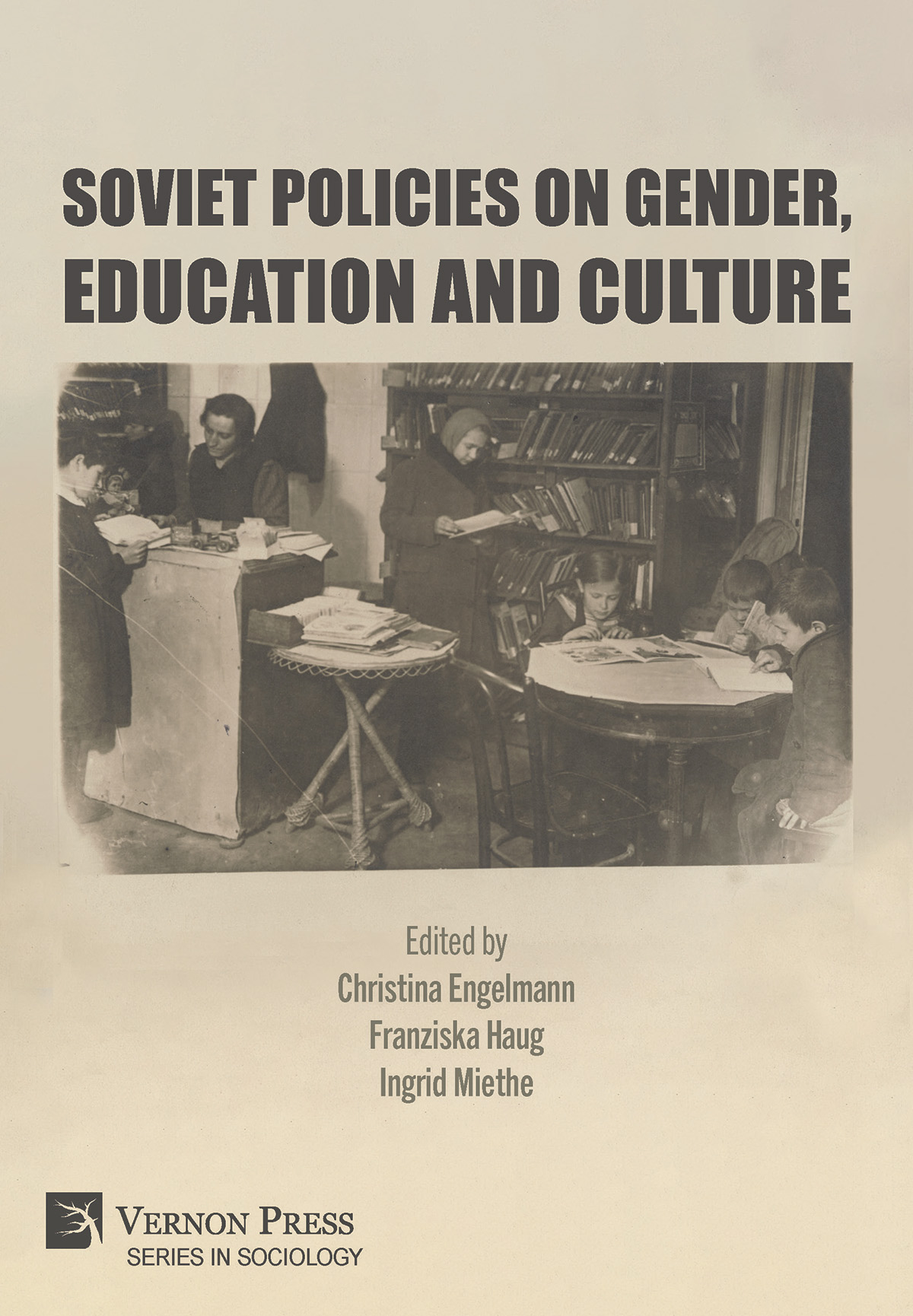
Soviet Policies on Gender, Education and Culture

Christina Engelmann, Ingrid Miethe, Franziska Haug (Eds.)

by Carlotta Chenoweth (United States Military Academy West Point), Simon Gurisch (Carl von Ossietzky University Oldenburg, Germany), A. Austin Garey (Kennan Institute, US), Jarvis Tyrell Curry (University of the Cumberlands, Kentucky), Mark B. Tauger (Institute for Advanced Study in Princeton, New Jersey, US), Kristen R. Ghodsee (University of Pennsylvania), Egan Chambers (University of Toronto), Dietmar Dath , Olivia Kennison (Brown University), Maria Momzikova Maria Momzikova (University of Tartu, Estonia)

Purchase this book

Hardback
$ 119
Availability: Pre-order

(24% discount on all pre-orders)

In times of increased East-West confrontation and various global crises, it becomes increasingly clear that, for most people, the neoliberal restructuring of society has not resulted in greater freedom or a more self-determined lifestyle. Instead, we are experiencing a precarization of working and living conditions, rising isolation, and a widespread sense of political powerlessness linked to the rise of right-wing governments, nationalist, and far-right forces in recent years. In light of these developments, it is especially important to take an unbiased look at concepts and practical models for alternative social and political change and to reflect on what lessons can be learned from historical events for today’s politics. The Soviet example appears particularly instructive, as the October Revolution of 1917 marked the start of a period of profound change in which a fundamentally different culture and education system emerged in just a few months and years. As this volume’s contributions demonstrate, the complex transformation process in the early years of the Soviet Union involved both the creation of new elements and the preservation of old ones.
As the interview with Kristen R. Ghodsee shows, figures like Alexandra Kollontai, through their progressive socialist theory and practice, brought about sweeping changes that extended beyond the sphere of production. They fundamentally transformed social life as a whole, especially gender relations, leading to significant improvements in living conditions – particularly for female workers – and achievements such as public childcare. The contributions and the interview with Dietmar Dath also explore the development of a new education system and the restructuring of art and culture, as well as their significance beyond the historical contexts in which they originated, continuing to influence today.
Through this, the volume aims to open new perspectives on the legacy of Soviet education, gender, and cultural policies and to provide insightful analyses and materials for researchers in disciplines such as educational sciences, history, art and cultural studies, literature, social and political science, anthropology, philosophy, and gender studies.

Christina Engelmann studied philosophy, sociology, political science, and German studies at Goethe University Frankfurt and the Université Paris-Sorbonne. She is a research associate at the University of Giessen and she is writing her doctoral thesis on the critique of the liberal notion of freedom from a materialist-feminist perspective at the Frankfurt Institute for Social Research (IfS), where she is co-spokesperson of the working groups 'Gender, Kinship, Sexuality' and 'Critical Education Research.' She also chairs the 'Forum kritischer Wissenschaften,' a scientific association that promotes critical research and education. Her research interests include social philosophy, critical theory, feminist materialism, and political education.

Franziska Haug studied art education, German studies, sociology, and gender studies in Frankfurt am Main, was a research assistant in the German literature department at Goethe University Frankfurt am Main, and wrote her dissertation on the relationship between labor and gender in literature and pop culture. She is currently a postdoc in the research network ‘Light On! Queer Literatures and Cultures under Socialism’ at the University of Regensburg, with a research project on queer GDR literature. She is chair of the collective ‘Forum kritischer Wissenschaften’ and ‘DiasporaOst’. Her research focuses on queer theory, materialist feminism, Marxism, pop culture, and antisemitism.

Ingrid Miethe completed her doctorate in political science at the Free University of Berlin and habilitated in educational science at the University of Halle-Wittenberg. Her research focuses on the history of education with an emphasis on GDR history and Eastern Europe, education and social inequality, as well as qualitative social research. She led a research project on workers' faculties in the GDR, Cuba, Vietnam, and Mozambique, as well as on the work of Clara Zetkin in the Soviet Union.

Soviet Union, Soviet pedagogy, socialist realism, women’s movement, materialist feminism, Clara Zetkin, Alexandra Kollontai, Vladimir Mayakovsky, Nadezhda Krupskaya, Vladimir Lenin, Education policy, literature, GDR, Russia, Proletkult, Russian Revolution, culture, educational sciences, pedagogy, literary studies, cultural studies, materialism, Marxism, socialism, Ukraine, Anatoly Lunacharsky, avant-garde art, Amaliia Khazanovich, production aesthetics, queerness, gender relations, Cold War, Soviet cultural and education policy, post-soviet transformations

SSL