Loading...
Please wait while we load the content...

Loading...
Please wait while we load the content...
Stay informed about our latest publications, calls for proposals, author news, events, and special announcements.
Join our community of scholars, librarians, authors, and readers and receive the latest updates from Vernon Press directly in your inbox.


Availability
In stock
ISBN
9781648893827
Edition
1
Publication Date
June 7, 2022
Physical Size
236mm x 160mm
Number of Pages
245
Currency
Quantity
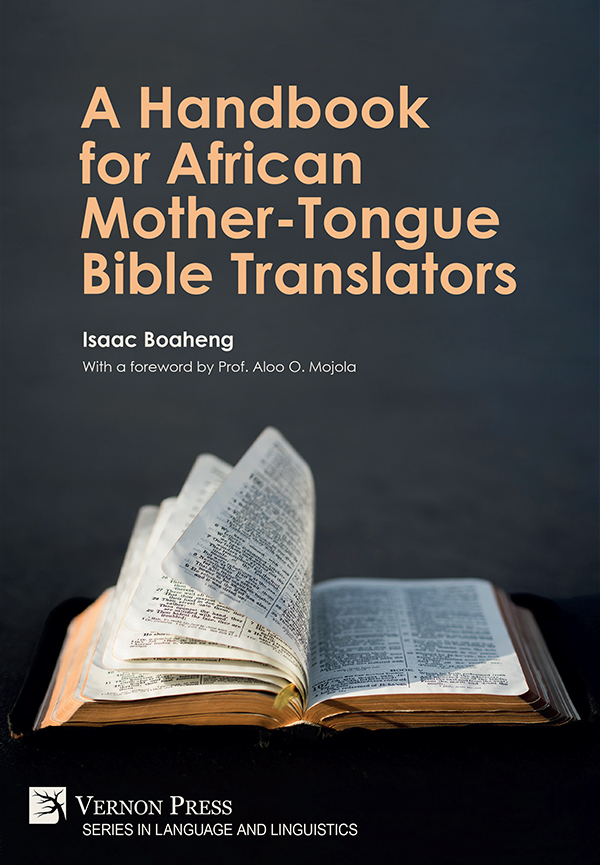
Bible Translation is not just a matter of transposing words from the Source Languages (SL) to Receptor Languages (RL). It is a process of communicating what the original authors of the Bible meant, to what they mean to mother-tongue Bible readers in their religio-cultural contexts.
“A Handbook for African Mother-Tongue Bible Translators” discusses the process of the art and science of Bible translation in a simple language, from historical, philosophical, theoretical, linguistic, cultural and practical perspectives. Written by an African Bible translator and for the African context, the book is a hands-on resource material for Bible translators in Africa. The book is a valuable textbook for postgraduate courses in “History and Theory of Bible Translation”, “Bible Translation and Interpretation” in the discipline of Bible Translation Studies; in universities and seminaries.
I recommend “A Handbook for African Mother-Tongue Bible Translators” to whoever wants to know the process of Bible translation from the original languages to mother-tongues.
Rev. Professor Jonathan Edward Tetteh Kuwornu-Adjaottor (PhD)
Professor of New Testament and Mother-Tongue Biblical Hermeneutics
Department of Religious Studies
College of Humanities and Social Sciences
Kwame Nkrumah University of Science and Technology
Kumasi, Ghana
This book “A Handbook for African Mother-Tongue Bible Translators” by Isaac Boaheng is a masterpiece and a classical guide into the art of Bible translation. It is academically sound and takes into account all the technical approaches, theoretical dispositions, and reflective exercises that inform the art of translation, not neglecting the ‘Sitz im Leben’ of African Bible translators or audiences. Its quality of scholarship is self-evident and pronounced by its clear goals regarding the book’s intention and basic purpose. The adequate presentation of recent developments in the field, the discussion of theoretical lenses that inform Bible translation, the use of appropriate methods, and reflective exercises that ensure the grasp of discourses by African audiences attest to its high quality of scholarship. The originality of the book further adds value to the existing body of literature in Bible translation and caters for Bible translators within the global and local (‘glocal’) contexts. The book is a resourceful material for audiences in Bible translation, biblical and religious studies. It is also user-friendly for non-academic audiences, such as lay-persons, preachers, and students of the Bible.
Dr. Joel Mokhoathi
Senior Lecturer in Religion Studies
University of the Free State, South Africa
Discover books that expand on the themes explored in this work—titles that engage with similar questions, intersecting disciplines, and complementary perspectives to deepen understanding and broaden the conversation.
Browse all titles