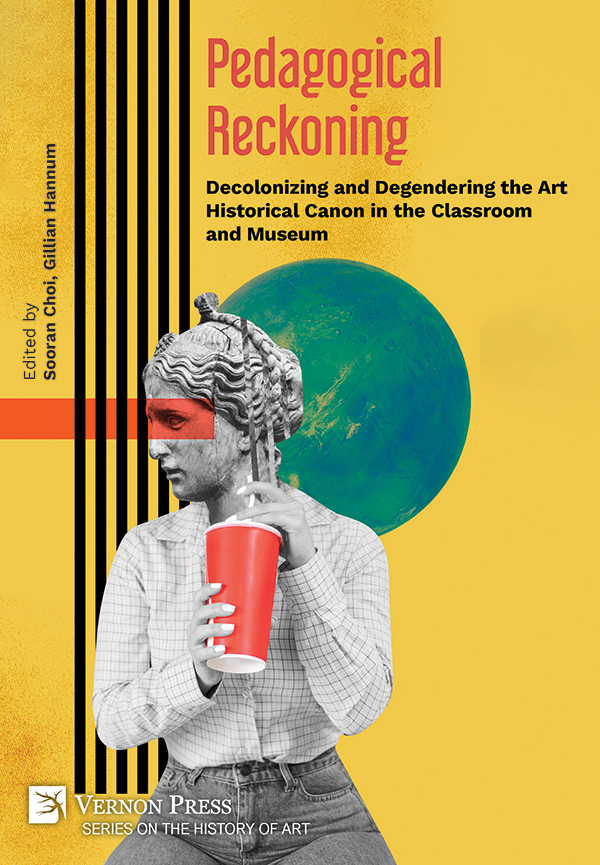
Pedagogical Reckoning: Decolonizing and Degendering the Art Historical Canon in the Classroom and Museum
Gillian Greenhill Hannum, Sooran Choi (Eds.)
by Victor Pitsoe (University of South Africa), Bokyung Kim (University of Mississippi), Gillian Greenhill Hannum (Manhattanville University), Sooran Choi (University of Vermont), Kyunghee Pyun (State University of New York; Fashion Institute of Technology), Nancy Eder (State University of New York; Fashion Institute of Technology), Kelsey Frady Malone (Berea College), Yan Yang (Borough of Manhattan Community College, City University of New York), Ila Sheren (Washington University), Anna Jozefacka , Malka Simon (Brooklyn College, City University of New York), Francesca Liuni (Rhode Island School of Design), Laura Phillips (University of Oklahoma), Ace Lehner (University of Vermont)
Purchase this book
(click here to change currency)
Academic scholarship is marked by a restless and invigorating urge to rethink and reassess its canonic conclusions. Art history is no stranger to this process, and in this exciting volume, the authors query how a rich new base of information diversifying the discipline can be included in undergraduate courses in a meaningful manner. Many fascinating real-life assignments add liveliness and heft to this anthology. This is a timely and important book.
Mona Hadler
Professor of Art History
Brooklyn College and the Graduate Center, CUNY
Art Department Chair, Brooklyn College
This is an insightful collection that addresses the multifaceted scholarship prevalent in art history research that is often lacking in the classroom. Most academic fields have their canon, but this is particularly true in art history, which has leaned on the Western narrative tradition with great tenacity. Bringing together expanded pedagogical, curatorial, and methodological concerns, this volume will prove a valuable resource for those who want to incorporate the diverse approaches that have been a significant aspect of art history investigation for many years.
Dr. Timothy W. Hiles
Art History, School of Art
University of Tennessee
Where there exists a strong passion for equality and justice as it pertains to race and gender, institutions of learning need a model that reflects an equal dedication to insightful and accurate research, as demonstrated in “Pedagogical Reckoning: Decolonizing and Degendering the Art Historical Canon in the Classroom and Museum.”
Through reading this text, I have gained a better understanding of the hardships of race, gender, and inclusion. I am continually impressed by the depth of theory, thoughtful application, and practical strategies presented in the writings.
“Pedagogical Reckoning: Decolonizing and Degendering the Art Historical Canon in the Classroom and Museum” has contributed not only to the removal of direct and indirect forms of exclusion but has also provided a valuable blueprint for tackling these problems head-on.
I look forward to implementing several of the exercises and activities offered in this comprehensive textbook in my courses, as they promise to be both impactful and transformative.
Randy Williams
Professor Emeritus
Manhattanville University
A must read for all art historians committed to retooling their teaching to seriously decenter whiteness and foster a compassionate, critically informed decolonial approach to art.
Dr. Siona Wilson
College of Staten Island; Graduate Center
The City University of New York
'Pedagogical Reckoning: Decolonizing and Degendering the Art Historical Canon in the Classroom and Museum' brings together leading voices in art history, museum studies, and pedagogy to confront the Eurocentric and patriarchal foundations of traditional art historical education. This timely anthology provides a range of actionable strategies for reshaping curricula, exhibitions, and research through the lenses of decoloniality, gender justice, and global inclusion.
Edited by Sooran Choi and Gillian Greenhill Hannum, the volume includes contributions from scholars, artists, and educators across institutional contexts—from large research universities to community colleges and art schools. Its chapters span three key areas: inclusive classroom pedagogy, critical museum and curatorial practice, and decolonial research methodologies. Essays explore intersectional frameworks informed by postcolonial theory, feminist critique, queer studies, and ethnic studies, while also providing practical tools such as sample assignments, case studies, and curatorial models.
Uniquely, this anthology integrates scholarly analysis with pedagogical reflection, offering readers both conceptual frameworks and concrete applications. It builds on recent literature such as 'Teaching South and Southeast Asian Art' and 'Expanding the Parameters of Feminist Artivism', while extending the conversation through its focus on classroom agency, community-responsive teaching, and institutional reckoning.
Ideal for art history instructors; museum professionals; and students in anthropology, cultural studies, and education, 'Pedagogical Reckoning' serves as both a critical resource and a methodological guide. It is suitable for classroom adoption, professional development, and curriculum planning, and will appeal to anyone committed to transforming the way we teach, curate, and write about art.
List of Figures
List of Tables
Acknowledgments
Contributors
Chapter 1
Introduction
Sooran Choi
University of Vermont
SECTION 1: In the Classroom/Pedagogy
Chapter 2
From Multiculturalism to Diversity, Equity, and Inclusion: How Teaching Art History Has Changed in the Twenty-First Century
Nancy Eder
State University of New York; Fashion Institute of Technology
Chapter 3
A Transformed Art History Classroom: Centering Students’ Voices, Concerns, Skill Sets, and Goals in the Art History Survey Course
Kelsey Frady Malone
Berea College
Chapter 4
Teaching Students How to Teach Their Own Cultural Heritage: A Case Study on Diversifying Perspectives in the Global Survey
Yan Yang
Borough of Manhattan Community College, City University of New York
Chapter 5
Embracing Un-Diversity: Redefining a Non-Western Art Survey in a Large Classroom Setting
Bokyung Kim
University of Mississippi
Chapter 6
Towards an Inclusive Teaching of Latinx Art History
Ila N. Sheren
Washington University
Chapter 7
Outside the Canon in the Outer Boroughs: New Pedagogy for New York’s Architectural History
Anna Jozefacka
Independent Scholar
Malka Simon
Brooklyn College, City University of New York
SECTION 2: Museum Architecture and Curatorial Practice
Chapter 8
The Bias of Museum Architecture: Questioning the Neoclassical and Modernist Typology of Western Museums
Francesca Liuni
Rhode Island School of Design
Chapter 9
Unsettling Curatorial Practices through Museum Studies: A Case Study of Our ‘5 Things’ Assignment
Laura Phillips
University of Oklahoma
Chapter 10
Decolonizing ‘Appropriation’: Heritage, Cultural Tourism, and Curatorial Practices in the Global South
Kyunghee Pyun
State University of New York; Fashion Institute of TechnologySECTION 3: Decolonizing Methodology and Research
Chapter 11
Queering Art History: Decolonizing Approaches to Art and Visual Culture
Ace Lehner
University of Vermont
Chapter 12
Decolonizing Higher Education Research Praxis through the Frames of Nabudere, Fanon, and Asante
Victor J. Pitsoe
University of South Africa
Chapter 13
Afterword
Gillian Greenhill Hannum
Manhattanville University
Index
Sooran Choi is Assistant Professor of Art and Art History at the University of Vermont, where her teaching and research focus on decolonization, global feminism, ecocriticism, and contemporary East Asian art. Her work critically engages with marginalized artistic practices, Cold War visual culture, and alternative pedagogies that challenge Eurocentric and patriarchal art historical frameworks. She has published in Rebus, Multiple Modernisms, and Religion and the Arts, with essays on South Korean performance art, shamanism, gender fluidity, and subversive aesthetics. Her scholarly and curatorial experience directly shaped 'Pedagogical Reckoning', which synthesizes theory and practice to promote institutional change. Choi has received major fellowships from the College Art Association, the Academy of Korean Studies, and the Mellon Foundation. She has taught at CUNY, NYU, and UVM, designing inclusive, interdisciplinary curricula. She also co-leads national initiatives on Korean/Asian studies, integrating intersectional pedagogy into academic and cultural institutions.
Gillian Greenhill Hannum is a Professor Emerita of Art History at Manhattanville University in Purchase, New York, where she served on the faculty from 1987 to 2021. A photo historian with M.A. and Ph.D. degrees from The Pennsylvania State University, she has published on photographic topics, has presented widely at national and international conferences, and has contributed to several books and exhibition catalogs. Most recently, she co-edited, with Kyunghee Pyun, 'Expanding the Parameters of Feminist Artivism' (2023) and a special issue of the journal 'Religion and the Arts' titled “Keeping the Faith: Religion, Gender, and the Arts in the Twenty-first Century” (2023). She continues to teach at Manhattanville on a part-time basis.
decolonization, Indigenous knowledge, African epistemology, queering, appropriation, artifacts, universal design, art history survey, critical pedagogy, canon critique, institutional critique, visual literacy, arts education reform, pedagogical equity, intersectionality in education, epistemic disobedience, critical museology, feminist pedagogy, inclusive curriculum design, decolonial aesthetics, anti-oppressive education, radical education theory, transnational pedagogy, art activism, knowledge production, critical race pedagogy, curatorial activism, educational justice
Subjects
Art
History
Education
Series
Series on the History of Art
Related services
Find in a library near you Download HQ cover Find in Bookshop.orgDOI: 10.54094/b-2a6045d1e0
Bibliographic Information
Book Title
Pedagogical Reckoning: Decolonizing and Degendering the Art Historical Canon in the Classroom and Museum
ISBN
979-8-8819-0385-5
Edition
1st
Number of pages
338