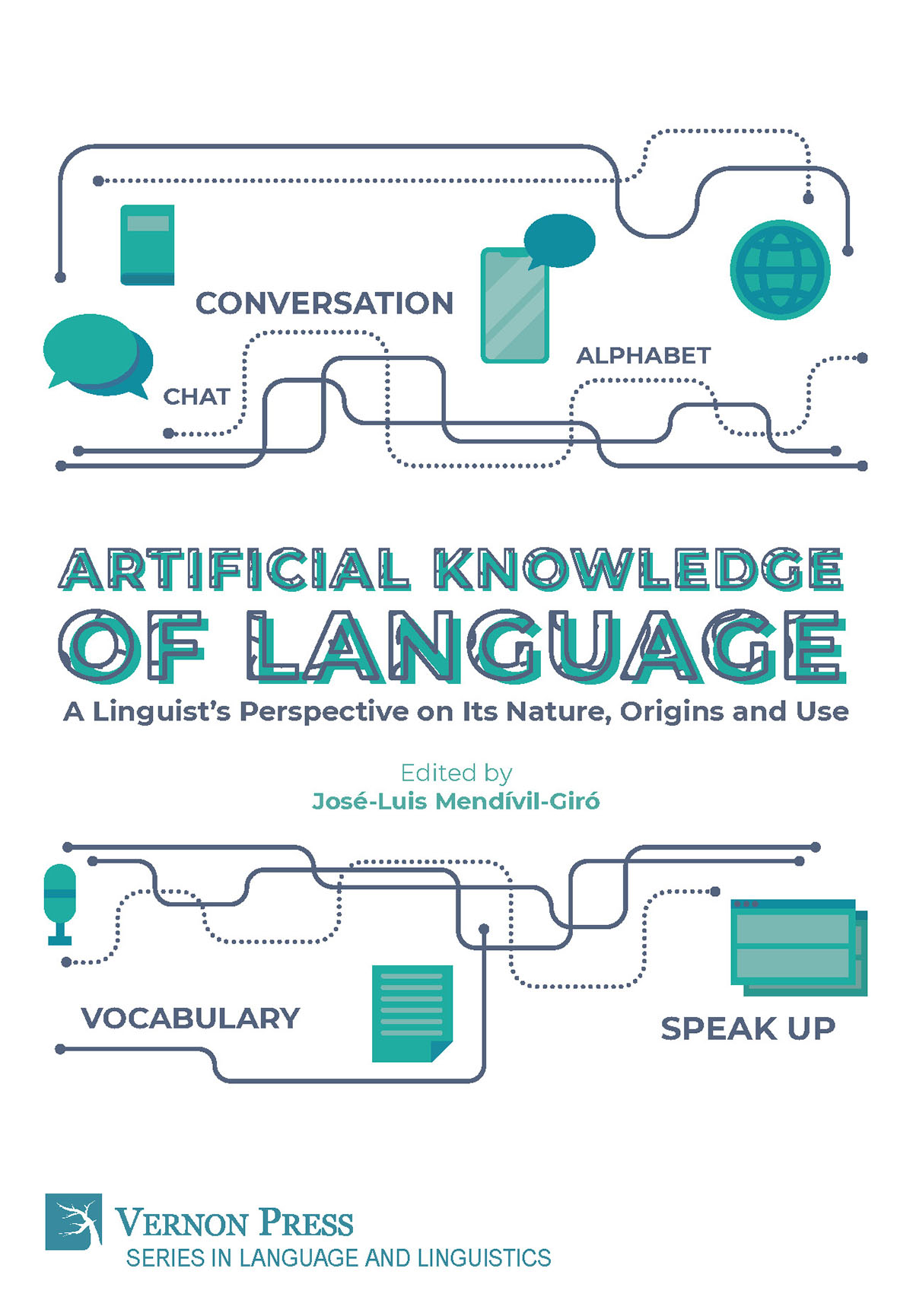
Artificial Knowledge of Language
A Linguist's Perspective on its Nature, Origins and Use
José-Luis Mendívil-Giró (Ed.)
Although Markov, Turing, von Neumann, or Chomsky never got a Nobel Prize, technologists developing their foundational ideas into Large Language Models surprisingly did: in 2024. The present book delves into the (for now) state-of-the-art in this saga, presenting it as dispassionately as possible through eight prismatic chapters. If readers wonder how momentous an epilogue and beyond can be, they only need to imagine the offspring of a next generation of such devices - albeit built beyond classical presuppositions in hardware, logic, or even modeling. The latter no longer seems like a chimerical possibility; whether that is for better or for worse, surviving the future may tell.
Dr. Juan Uriagereka
Professor, Linguistics & SLLC
University of Maryland
A comprehensive and wide-ranging overview of the issues (and non-issues) raised for linguistic theory, particularly Chomskyan linguistic theory, by the development of Large Language Models. The editor's introduction is particularly useful. Highly recommended for linguists, including computational linguists, of all persuasions, as well as computer scientists, philosophers and psychologists with an interest in language and AI.
Dr. Ian Roberts
Professor of Linguistics
University of Cambridge
The central question that this volume seeks to answer is: What are the similarities and differences between how human beings know language and how artificial intelligence knows language? The recent development and popularization of artificial intelligence systems called Large Language Models (such as ChatGPT) have led to a proliferation of opinions regarding the relevance of these systems beyond the practical purposes for which they were designed. It is not uncommon to find statements in social networks and popular magazines, as well as in academic publications, to the effect that these language models have solved the problems that sciences such as linguistics aim to solve, that their success in generating text can be seen as a refutation of some particularly influential theories of language, or that Language Models are actually scientific theories of language. These statements seem to be based on the premise that the linguistic knowledge acquired by these systems is comparable to that developed by humans. This book aims to evaluate whether this assumption is warranted. To this end, the opinions of renowned linguists and other cognitive scientists have been gathered to answer questions such as what kind of language knowledge these artificial systems have, to what extent they are faithful models of natural language knowledge, and what we can learn about the human language faculty by examining their inner workings. Anyone interested in the nature of human language and mind and in artificial intelligence can follow the eight chapters of the book without being an expert in linguistics or computer science. This is the first comprehensive work to present the views of experts in linguistic theory on the relevant questions mentioned above, and to provide an accessible presentation of current research on the nature of artificial knowledge of language.
José-Luis Mendívil-Giró (editor) is a full professor of General Linguistics at the University of Zaragoza and Principal Investigator of the 'Psylex (Language and Cognition)' group at the same University. His research has focused on the theory of grammar, the philosophy of linguistics, and the nature and extent of language change and diversity. He has published research articles on these subjects in journals such as 'Folia Linguistica, Journal of Linguistics, Linguistics, Frontiers in Communication, Glossa, Biolinguistics and Theoretical Linguistics'. He is the author of five books, including 'On Biology, History and Culture in Human Language. A Critical Survey' (2014, Equinox, with J.C. Moreno). In addition to academic publications, Mendívil-Giró writes short essays on the nature of language, of languages, and linguistics itself on the blog 'Philosophy of Linguistics' (hosted on Wordpress).
Artificial Intelligence, Language, Language Models, Cognitive Science, Language Acquisition, Philosophy of Science, Knowledge of Language, Generative Grammar, Cognitive Linguistics, Syntax, Semantics, Morphology, Computer Science, Impossible Languages, Natural Language Processing
Subjects
Language and Linguistics
Cognitive Science and Psychology
Series
Series in Language and Linguistics
Related services
See also
Bibliographic Information
Book Title
Artificial Knowledge of Language
Book Subtitle
A Linguist's Perspective on its Nature, Origins and Use
ISBN
979-8-8819-0379-4
Edition
1st
Physical size
236mm x 160mm