INDEPENDENT PUBLISHER OF BILINGUAL SCHOLARLY BOOKS IN THE HUMANITIES AND SOCIAL SCIENCES

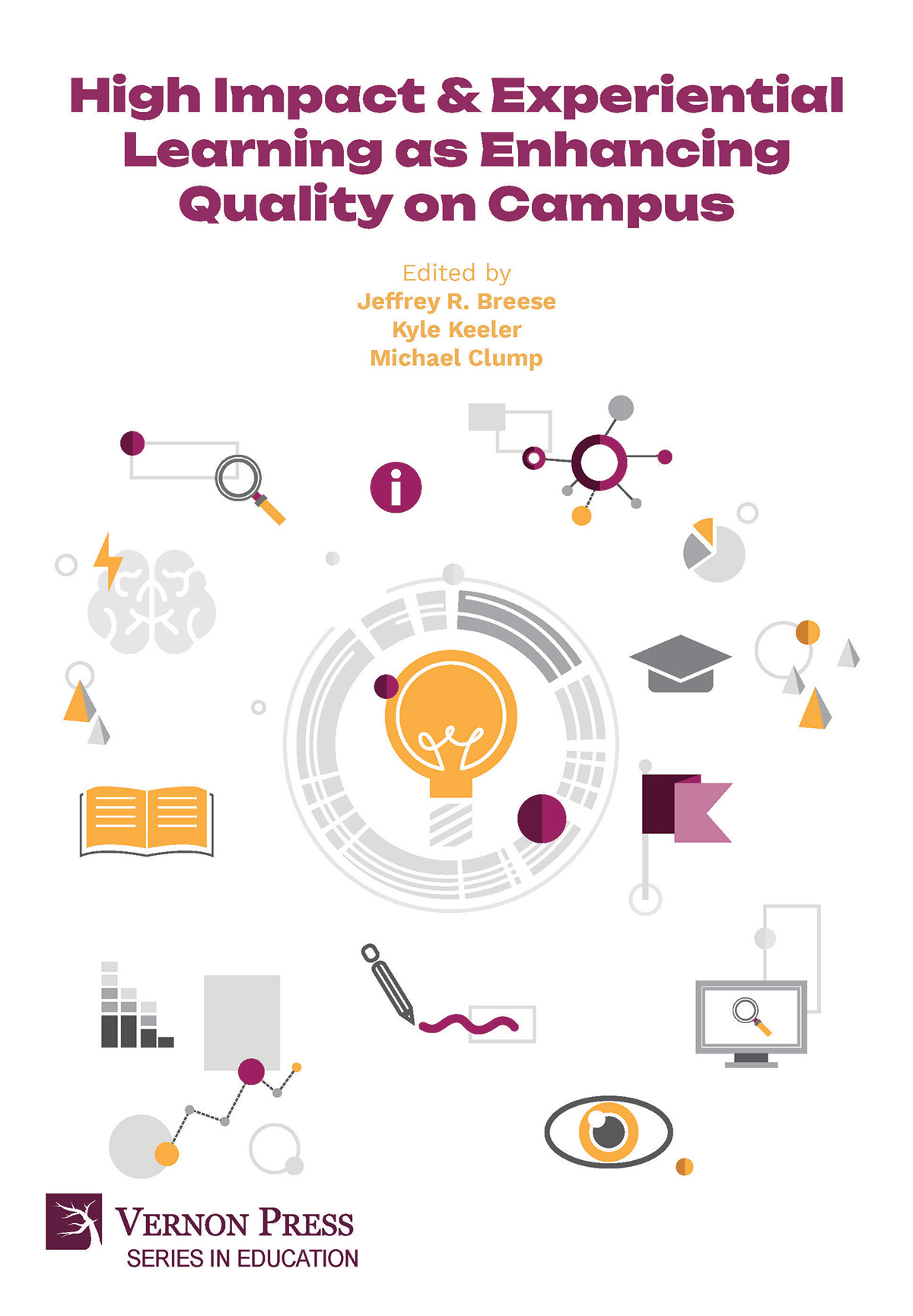
High Impact & Experiential Learning as Enhancing Quality on Campus

Jeffrey R. Breese, Kyle Keeler, Michael Clump (Eds.)

by Joseph M. Incandela (Benedictine University), Andrew Moyer (Delaware Valley University (DelVal)), Laura Craig (Delaware Valley University (DelVal)), Celine R. Fitzmaurice (Portland State University), Seanna Kerrigan (Portland State University), Harold McNaron (Portland State University), Hande Buyuksahin (Portland State University), Erica Wagner , Courtney DeMayo Pugno (Heidelberg University), Ashley Helmstetter (Heidelberg University), Kyle Keeler (Lafayette College), Ernest Nkansah-Dwamena (Lafayette College), Kathryn A. Lynch (University of Oregon)

Purchase this book

Hardback
$ 114
Availability: In stock
currency displayed based on your location
(click here to change currency)

Thank you to the authors for this timely and powerful contribution to higher education. The book strikes a rare and effective balance of sophistication in its research and framing, yet practical and actionable for educators and leaders. By illuminating the essential value of high-impact practices and experiential learning, it provides both vision and tools to create transformative educational experiences for students. A must-read for anyone committed to meaningful student success and institutional innovation.

Trevor M. Bates, DHSc, MS, AT
Fmr. President
Mercy College of Ohio and Wilmington College


This collection presents a fresh perspective on high-impact and experiential education that begins with useful project summaries based in personal experience and reflection but goes beyond typical educational practice books by engaging with pedagogical history, providing cautions and limitations that are informed by this history, and outlining how programs and practices have been structured in different circumstances. In this way, it provides a highly useful introductory pedagogical toolkit—and sense of context—for those new to university instruction while also providing engaging pointers and familiar ‘ah ha’ and ‘oh no’ moments for those already well-versed.

Dr. Daniel Shtob
Brooklyn College


Reading this book provides myriad creative examples of experiential learning initiatives across a diverse spectrum of higher educational institutions. Small colleges, public and private institutions, and larger universities represented showcase programs aligned with mission and/or strategic plans to meet contemporary ideals of education. What is exemplary about this text and the examples provided is their grounding in theory and well-researched scholarship.

Karen Ristau. Ed.D.
Former president,
National Catholic Educational Assocation;
Full professor. Retired,,
University of St. Thomas. St. Paul, MN

For years, the American Association of Colleges and Universities (AAC&U) has called for colleges and universities to implement high-impact practices (HIPs), or educational procedures that provide significant academic advantages to students. 'High Impact & Experiential Learning as Enhancing Quality on Campus' provides examples of such strategies from thirteen colleges and universities as they have been applied in the classroom and in service of each featured college and university’s mission statement and quality enhancement plan. Each institution included in this collection has committed to some such project or initiative (in some cases, the commitment goes back multiple decades), and each reflects the diversity of contemporary higher education in the United States. Public and private, small and large, selective and open access, religiously affiliated and non-sectarian, are all included here. The institutions provide a variety of creative examples of implementing experiential learning and the myriad HIPs as identified by the AAC&U, including: Capstone Courses and Projects, ePortfolios, First-Year Seminars and Experiences, Service Learning/Community-Based Learning and Undergraduate Research. Each chapter is framed around the project’s scope and significance, a clear expression of the purpose of the project, evidence of the institution’s commitment and capacity for the effort and how the project is aligned with stated goals and institutional priorities. Drawing from fields as broad as sociology, psychology, the humanities, and environmental sciences and studies, 'High Impact & Experiential Learning as Enhancing Quality on Campus' appeals to multiple classrooms and institutional goals. Given the expanded interest in experiential learning/HIPs in higher education over the past two decades, this first-of-its-kind collection offers a roadmap for faculty and administrators to implement the practices outlined in each chapter in service of students’ learning and their larger institutional goals.

List of Tables
Introductory Chapter
Jeffrey R. Breese
Lorain County Community College
Chapter One
Periculum in the Curriculum: The Danger of Experiential Education
Joseph M. Incandela
Benedictine University
Chapter Two
Experiential Learning: Delaware Valley University’s Legacy with this High Impact Practice
Andrew Moyer
Delaware Valley University (DelVal)
Laura Craig
Delaware Valley University (DelVal)
Chapter Three
Engaging for Justice: An Institutional Journey Toward Critical Community-Engaged Learning
Celine R. Fitzmaurice
Portland State University
Seanna Kerrigan
Portland State University
Harold McNaron
Portland State University
Hande Buyuksahin
Portland State University
Erica Wagner
Independent Scholar
Chapter Four
HYPE Career Ready® & Placement: Heidelberg University’s Co-Curricular Program to Prepare Students for Life After Undergrad
Courtney DeMayo Pugno
Heidelberg University
Ashley Helmstetter
Heidelberg University
Chapter Five
Lafayette College’s Commitment to Campus Quality: Enhancing Education through Experiential Learning and Community-Based Research for Food Justice
Kyle Keeler
Lafayette College
Ernest Nkansah-Dwamena
Lafayette College
Chapter Six
Fostering Collaboration, Civic Engagement, and Career Skills through Community-Engaged Learning: The Environmental Leadership Program at the University of Oregon
Kathryn A. Lynch
University of Oregon
Peg Boulay
University of Oregon
Chapter Seven
Integrative Learning and ePortfolio: Investing in Student Engagement to Support Strategic Priorities
Stephane Fratantaro
Gwynedd Mercy University
Chapter Eight
(Re)Mapping the Blueprint: High-Impact Practices in Service Learning and Civic Engagement
David M. Reis
Hilbert College
Chapter Nine
Leadership and Belonging: Strengthening Community through the Five Components Model
Mark Miller
Marietta College
Alexandra Perry
Marietta College
Chapter Ten
Otterbein READY: Anticipate, Engage, Reflect, Transition
Kathryn M. Plank
Otterbein University
Suzanne Ashworth
Otterbein University
Jennifer Bechtold
John N. Gardner Institute for Excellence in Undergraduate Education
Wendy Sherman Heckler
Otterbein University
Leah Schuh
Ohio State University
Chapter Eleven
Expanding Opportunities and Success with OpSTEM
Juan Amador
Cleveland State University
Jessica Douglas Cunion
University of Mount Union
Sara Froehlich
Cleveland State University
Chapter Twelve
Issue-Based Experiential Projects in an Honors
Curriculum
David Lisenby
William Jewell College
Keli Braitman
William Jewell College
Kelli Schutte
William Jewell College
Chapter Thirteen
Liberal Arts Are Critical for High-Impact Sustainability Education
Holly Moulton
College of the Holy Cross
Chapter Fourteen
Amplifying High-Impact Practices with Exemplars: Affirming the Nexus Among Mission, Strategic Planning, and Accreditation
Kristine Lynn Still
Youngstown State University
About the Contributors
Index

Jeffrey R. Breese, Ph.D., is Dean of Accreditation & Assessment of Student Learning at Lorain County Community College. He is a sociologist who has completed significant work in service-learning and community-based research as a faculty member. He has served as a chief academic officer for a decade and has extensive experience with accreditation and strategic planning linked to the themes of this book. He is a past president of the Society for Applied Sociology.
Kyle Keeler, Ph.D., Assistant Professor of Environmental Sciences and Studies at Lafayette College. His work has focused on community-based research and pedagogy in the interdisciplinary environmental studies, specifically the environmental humanities, environmental justice, Indigenous studies, climate justice, and legal studies. He has partnered with Indigenous community members and organizations to produce educational materials to be utilized by Tribal Nations, and he has worked with students to complete community-based internship projects and produce digital educational materials for a public audience outside of the academy.
Michael Clump, Ph.D., serves as Vice Provost for Academic Excellence and Effectiveness at Rockhurst University. He is a psychologist who has focused on the scholarship of teaching and learning while a full-time faculty member and has also engaged students in high-impact practices by supervising them in research collaborations, internships, and teaching assistantships. He has held a number of leadership positions, including department chair, director of a university’s core/general education program, Dean, and associate provost over twenty years in higher education. Dr. Clump has specialized in institutional and program assessment, plus data analysis of academic fiscal effectiveness, for the past ten years.

Assessment, Accreditation, Strategic Planning, Institutional Mission, Service-Learning, Curriculum, Experiential Education, High Impact Practices (HIPs), Pedagogy, Disruptive Innovation, Environmental Justice, Civic Engagement, Honors

See also

Bibliographic Information

Book Title

High Impact & Experiential Learning as Enhancing Quality on Campus


ISBN

979-8-8819-0401-2


Edition

1st


Number of pages

274


Physical size

236mm x 160mm


Publication date

February 2026
SSL