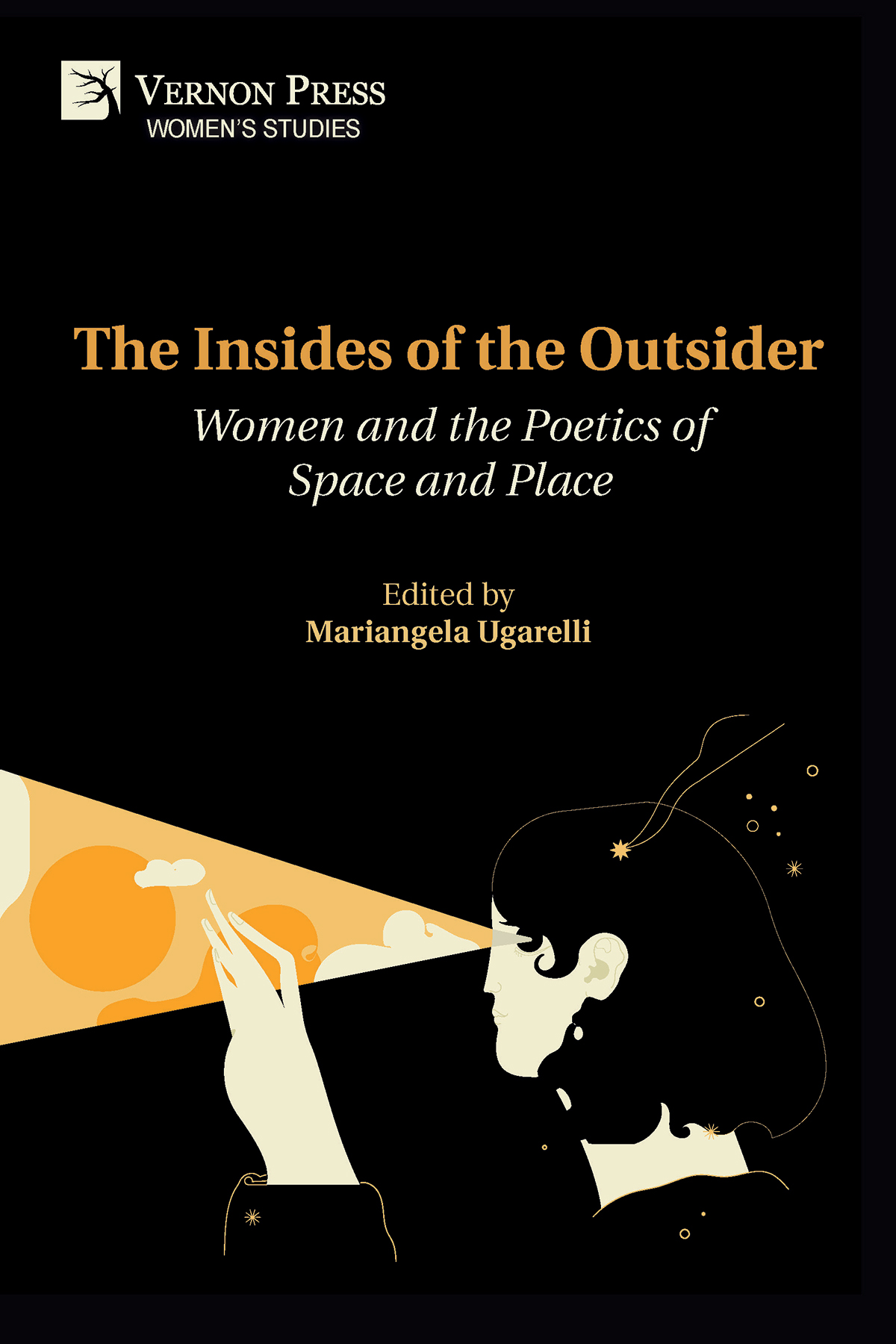
The Insides of the Outsider: Women and the Poetics of Space and Place
Mariangela Ugarelli (Ed.)
by Jhonn Guerra Banda (Berea College), Juan Diego Perez , Lauren Benjamin Mushro (Universitat de Vic - ELISAVA), Mariangela Ugarelli , Cecilia Esparza (Pontificia Universidad Católica del Perú, Peu), Rachel Williams (Johns Hopkins University), Erna Anderson (College of William & Mary), Lisu Wang (Centre for Victorian Studies at the University of Leicester), Alexandra Arana Blas (University of Pittsburgh), Liliana Galindo Orrego (Universidad del Valle), Victoria Mallorga Hernández
“The Insides of the Outsider” offers a lucid, transnational map of how women transform space: unhousing the Gothic home, queering the city, and deterritorializing borders. A timely and compelling volume for scholars of literature, space, and feminist theory.
Dr. Carmen Araujo
Hispanic Literatures & Cultures
University of California, Santa Barbara
The volume “The Insides of the Outsider: Women and the Poetics of Space and Place” explores the significance of the encounter between subject and object, relying on the ideas of Deleuze and Guattari as a central point of reference. The contributors aim to deterritorialize ideological assemblages by focusing on the unresolved movements of voices marked by the chiaroscuros of concealment and ambush, the horror and novelty of technology, suffocating and rarefied homes, and the struggle between self-perception and the gaze of others. The reader will find articles seeking to uncover the revolutionary potential of the eros in literature, cinema, and artistic expression, aiming to make space speak and even reach the unknown territories of the cosmic. The authors navigate a wide range of aesthetics, moving from the Baroque, Gothic, and Naturalism to the Neo-avant garde, alongside the most recent theoretical currents contributed by colonial studies, queer theory, affect theory, posthumanism, black studies, and migration studies. The volume maintains the historical rigor demanded by putting into dialogue the varied linguistic and cultural zones of authors from the Hispanic, Lusophone, Francophone, and Anglophone worlds, and the connections required for a global appreciation of poetics that exceed and question the scale of the intimate in the redefinition of space.
Alexis Hernando
University of Pennsylvania
The articles in “The Insides of the Outsider: Women and the Poetics of Space and Place” by Mariangela Ugarelli (ed.) move through the in-between spaces where feminine subjectivities navigate homes, institutions, diaspora, the limits of life and death, and desire—challenging borders both visible and unseen. This stunning work powerfully explores the role of female and queer subjects in creating alternative spaces and how their movement through becomes an act of transgression and self-assertion. This book offers a bold, intimate portrait of feminine experience in flux across diverse traditions, periods, and literary movements.
Dr. Rocío del Águila Gracey
College of William and Mary
When asked if being a woman had a negative impact on her ability to succeed as a writer, Argentine poet Alejandra Pizarnik stated that, even if not a physical impediment, being a woman in a patriarchal society is ‘a tragedy’ in itself. She followed this comment by saying: ‘What matters is what we do with our own tragedies’. Beyond sex assigned at birth, feminized bodies around the world share a similar phenomenological experience, which is dictated by a complicated relationship to space. Before setting pen to paper, the woman writer, a monster herself within patriarchal discourse, must confront the role society has set for her. For a writer in a feminized body, thus, the act of writing never begins with a tabula rasa but with a refusal and a challenge, an ushering out of the supposed ‘eden’ of the domestic.
The question of the women-writer’s space is further exacerbated when considering matters of intersectionality. The poetics of space and place change within the confines of different geopolitical structures and their relations amongst each other. How do they shift when the center becomes de-centered and writing stems not from a place of political power but from the quieted voices of minor literature, queer and racialized bodies or subalternized latitudes? This volume will attempt to address these questions with input from a diverse group of scholars dealing with an equally diverse corpus. North and Latin America converse with Europe while ‘genre’ literature, minor literature and ‘gendered’ literatures take center stage. By taking into account a wide array of cultural objects, from poetry and children’s literature to Gothic tales and television shows, this collection of articles reveals the profound link between space and the female experience through the lens of art and literature.
Introduction
Cecilia Esparza
Pontificia Universidad Católica del Perú
PART ONE IN-FRAME: FEMINIZED BODIES, FEMINIZED SPACES
Chapter One
Sor Juana’s Assemblages: Writing Relations in Los empeños de una casa
Rachel Williams
Johns Hopkins University
Chapter Two
Breaking Domestic Borders: A Discussion of Elizabeth Gaskell’s French Life
Lisu Wang
Centre for Victorian Studies at the University of Leicester
Chapter Three
From Zoo to Home: First Homes, Other Homes, and Work in Homes in Jean Webster’s Novels
Erna Anderson
College of William & Mary
Chapter Four
Solas, pero con un odio…: The Gothicized HomeTurned-Weapon in Amparo Dávila’s “El huésped”
Mariangela Ugarelli
Independent Scholar
PART TWO: OUT OF FRAME: MIGRATION, MOVEMENT, AND RADICAL BODIES
Chapter Five
Milhas/linhas: Vimala Devi and the Deterritorialization of Indo-Portuguese Female Canon
Lauren Benjamin Mushro
Universitat de Vic - ELISAVA
Chapter Six
Inviting Reality to Switch Sides: Eros and the Place of the Possible in Cecilia Vicuña’s Early Poetry
Juan Diego Pérez Moreno
Independent Scholar
Chapter Seven
Queer Voices, Queer Spaces: Relationships Between Spaces, Objects, and Characters in Peruvian Literature of the Nineties
Alexandra Arana Blas
University of Pittsburgh
Chapter Eight
The Aquatic Voice: Place, Body, Memory and Words in Migraciones by Gloria Gervitz
Liliana Galindo Orrego
Universidad del Valle
Chapter Nine
The Very Body of the Crime: Post-humanism, Bodies and the Cosmic Unknown
Victoria Mallorga
Independent Scholar
Epilogue: Unbounded Spaces: Gendered Bodies and Poetic Resistance
Jhonn Guerra Banda
Berea College
About the Contributors
Index
Mariangela Ugarelli is a writer, artist, and scholar born in Lima, Perú. Ugarelli received her Ph.D. in Spanish from Johns Hopkins University and her B.A. in Hispanic Literature from Pontificia Universidad Católica del Perú. As a writer, she has published two short story collections, 'Artilugios' (2022) and 'Fieras' (2023), which explore her interest in the intersection between the Gothic and representations of nature. Her academic work encompasses Latin American Gothic, horror and other so-called minor literatures, the female Gothic, and eco-Gothic as well as Latin American visual culture. Ugarelli’s scholarly work on said topics has been published in journals such as 'Gothic Nature', 'Brumal', and 'Latin American Literary Review'. She currently resides in the United States, where she is writing her third book.
Migration studies, feminism, comparative literature, romance studies, posthumanism, postcolonial studies
Subjects
Art
Sociology
Language and Linguistics
Series
Women's Studies
Related services
Download HQ coverSee also
Bibliographic Information
Book Title
The Insides of the Outsider: Women and the Poetics of Space and Place
ISBN
979-8-8819-0434-0
Edition
1st
Number of pages
170
Physical size
236mm x 160mm