INDEPENDENT PUBLISHER OF BILINGUAL SCHOLARLY BOOKS IN THE HUMANITIES AND SOCIAL SCIENCES

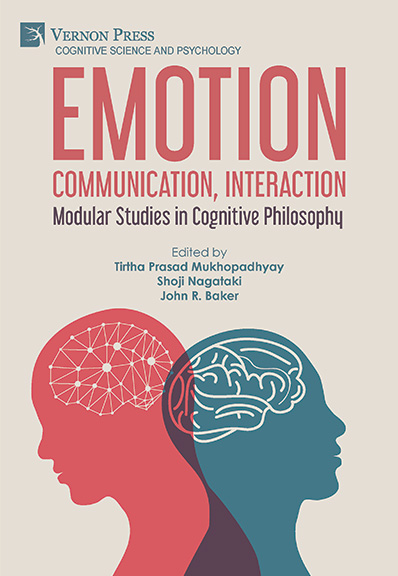
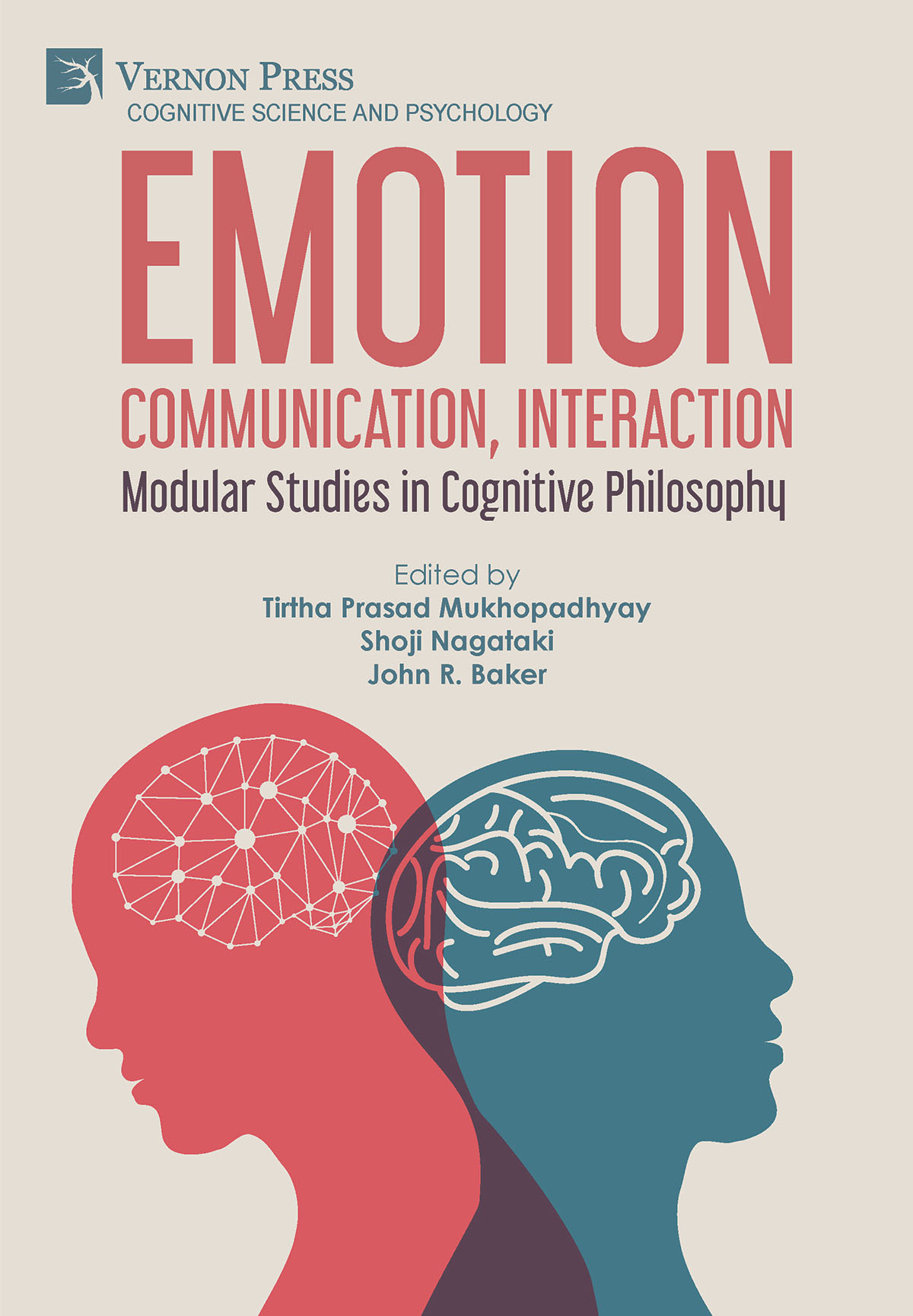
Emotion, Communication, Interaction: Modular Studies in Cognitive Philosophy

Tirtha Prasad Mukhopadhyay, Shoji Nagataki, John R. Baker (Eds.)

by Mario Verdicchio (University of Bergamo, Italy), Tatsuya Kashiawabata (Keio University, Tokyo, Japan), Toshihiko Miura (The University of Tokyo, Japan), Hideki Ohira (Nagoya University, Japan), Sônia M. G. Gondim (Federal University of Bahia, Salvador, Bahia, Brazil), Ana C.A. Simões (Instituto de Psicologia, Universidade Federal da Bahia, Bahia, Brazil), Ana L.M. Teixeira (Universidade Estácio de Sá, Rio de Janeiro, Brazil), Francisco Lagardera-Otero (Grupo de Investigación en Acción Motriz (GIAM); Instituto Nacional de Educación Física de Catalunya (INEFC), Universidad de Lleida, Spain), Pere Lavega-Burgués (National Institute of P hysical Education of Catalonia (INEFC), University of Lleida, Spain), Joseba Etxebeste (University of the Basque Country (EHU-UPV), Vitoria, Spain), José I. Alonso-Roque (Faculty of Education, University of Murcia, Murcia, Spain.), Javier G Garcia (Educational Sciences Department, School of Education, University of Burgos, Spain)

Purchase this book

Hardback
$ 120
Availability: Forthcoming

'Emotion, Communication, Interaction: New Perspectives for Cognitive Philosophy' consists of a handful of reflective, theoretical, and analytic essays on the nature and functions of human emotions and communicative strategies based on the most recent advances in the understanding of human emotions and communications in the academy. Broadly based on the philosophy of cognitive architecture of emotions, this volume of essays concludes by suggesting fresh methods of evaluating emotional behavior. As such, they create theoretical and, in some cases, qualitatively valid pathways for understanding what emotions mean and represent in the scale of human evolution and how the potential for emotions and effective emotional communication can benefit human life and well-being. The authors suggest how aesthetic emotions constitute a significantly new area of research on fine-tuned and less understood collective or cultural expressions. Fresh insights into the intersubjective nature of emotional communication, and strategic interactions among humans and between humans and machines, redefine the limits of human emotion and the extent to which emotions are underwritten in the anthropocene. Furthermore, such an important faculty as that of emotion, when studied in sociological contexts of competitive sports philosophy, prosocial behaviour, altruism, and collective nostalgia, opens up these different possibilities for the achievement of mental hygiene and well-being. This book will stand as an excellent reference for research on the efficacy of emotional life and its impact on the grand objective of happiness. Though epistemological variations mark the methods of discourse, the essays in this volume tout emotional cognition and communications as a viable alternative in a post-enlightenment world of fresh evolutionary insights and moments.

Tirtha Prasad Mukhopadhyay is Professor of Art and Enterprise at Universidad de Guanajuato, Mexico. He taught at Presidency University of India (1996-2000), University of Calcutta (2000 -2016) and at the University of Texas at Dallas from 2002 to 2005, before migrating to Mexico. He was a Fulbright-Nehru Senior Research Fellow at the University of California, Santa Cruz, USA, from 2013-2014. His published books include 'Iconicity of the Uto-Aztecans', NY: Berghahn. 2023, 'Affective States in Art' (Proquest-UMI: 2005), 'Cezanne to Picasso' (Calcutta University Press, 2021). He has published more than 50 articles on emotion studies, creativity, cognition and aesthetics (published, for example, from IOS Press), digital art (published from MIT Press), visual anthropology (published from Atelier-Etno CISENP) and literature (from OUP). Mukhopadhyay writes poetry in the Bengali language. He was a Chief Editor of an indexed journal (2009-2023). He has been a Member of the National System of Research in Mexico since 2016, a Member of the Dean’s Advisory Council of Arts & Humanities at the University of Texas at Dallas, and a reviewer for some European Union project funding.
Shoji Nagataki is Professor, Chukyo University, Division of International Human Studies, School of Global Studies, Nagoya, Japan. His research output is dedicated to phenomenology, cognitive phenomenology, philosophy of embodiment, and philosophy of mind. Some of his research works are: Niberati, Nicola and Nagataki, Shoji. Vulnerability under the Gaze of Robots: Relations among Humans and Robots, AI & SOCIETY, 34. 2019. Nagataki, Shoji. “Touching the World as It Is,” 'Humana.Mente Journal of Philosophical Studies 31', 2016. Nagataki, Shoji et al., ed. 'Enigma of Emotion and Qualia'. Kyoto: Showado (in Japanese). 2008. Nagataki received the Outstanding Research Award HAI (Human-Agent-Interaction) in 2014, and the HAI Watsuji Prize (1995) from the Japanese Society for Ethics. He is also Vice President of The Society for Phenomenology and Media (2019-), Board Member of 'Rupkatha Interdisciplinary Journal' (since 2020), and Board Member of The Society for Phenomenology and Media (since 2013).
John R. Baker is a researcher/lecturer at the Faculty of Foreign Language at Ho Chi Minh City University of Industry and Trade and a research fellow at Shinawatra University, Thailand. He has worked with writing and self-access centers and taught writing, ESOL, and literature in the U.S.A. and Asia (Korea, Taiwan, Thailand, and Vietnam). His research interests include second language writing and reading, self-access and writing center administration, and research methods as these come together in an interdisciplinary matrix. He is an active member of TESOL organizations, regularly publishes, edits, and reviews for several journals, and has worked with international and local book publishers.

See also

Bibliographic Information

Book Title

Emotion, Communication, Interaction: Modular Studies in Cognitive Philosophy


ISBN

979-8-8819-0369-5


Edition

1st


Physical size

236mm x 160mm


Publication date

February 2026
SSL