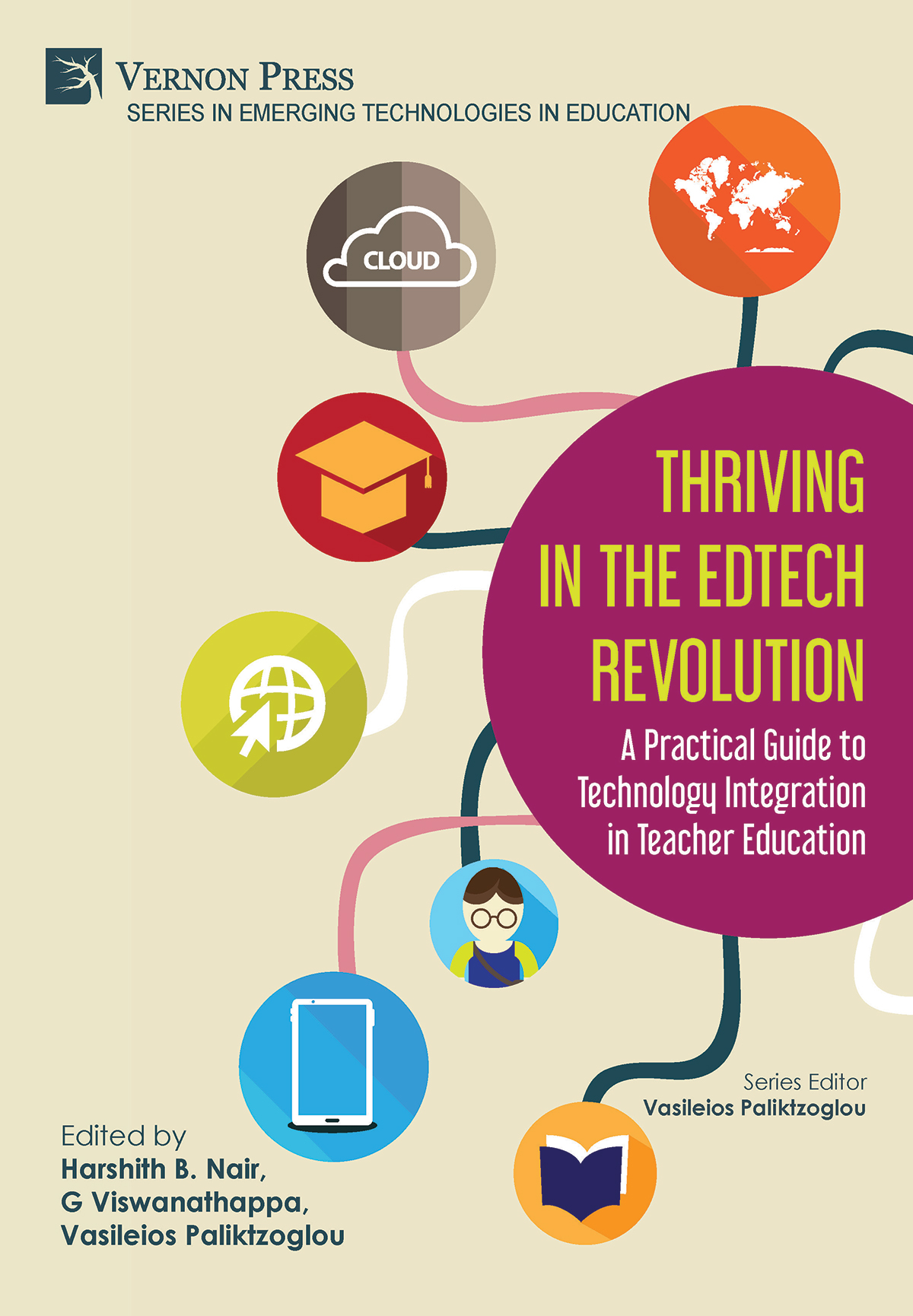
Thriving in the EdTech Revolution: A Practical Guide to Technology Integration in Teacher Education
Harshith B. Nair, Vasileios Paliktzoglou, G. Viswanathappa (Eds.)
by Ivy Shen (Southeast Missouri State University, Missouri, USA), Anna Tomańska (Wrocław University of Environmental and Life Sciences, Poland), Emily Wilson (Faculty of Education, University of Melbourne, Australia), Pauline Black (University of the Highlands and Islands (UHI) Orkney, Scotland, UK), Abdul Raffie Naik (VIT-AP University, Amaravati, Vijayawada, Andhra Pradesh, India), Beenish Rasool (VIT-AP University, Amaravati, Vijayawada, Andhra Pradesh, India), Soumya Thankam Varghese (O.P. Jindal Global University, Haryana, India), Alka Ranjan (Jain (Deemed to be University), Bengaluru, India), Alfredo Landaeta (Government of Montserrat), Sunita Maharaj-Landaeta (University of Trinidad and Tobago, Republic of Trinidad and Tobago), Abirlal Mukherjee (GITAM (Deemed to be University), Bengaluru, India), Elhadj Moussa BenMoussa (University of East London, London, UK), Jana Gerard (Southeast Missouri State University, Missouri, USA), Alpana Bhattacharya (Queens College, City University of New York (CUNY)), Bonashri Gogoi (Tezpur University, Assam, India), Marina Bantiou (University of Thessaly, Greece), Grace Okubo (Association of Professional Futurists, Nigeria), Dhananjay Arun Kumbhar (Sanjivani University, Kopargaon, Maharashtra, India), Smita Tukaram Kumbhar (Sanjivani College of Pharmaceutical Education and Research (Autonomous), Kopargaon, Maharashtra, India), Amit Nitinrao Kolhe (Sanjivani Group of Institutes, Kopargaon, Maharashtra, India), Yashi Goyal (Central Institute of Education, University of Delhi, New-Delhi, India), Vijayalakshmi A. (CHRIST (Deemed to be University), Bangalore, India), Shraddha Verma (Kalinga University, Chhattisgarh, India), Vanitha C. (Central University of Kerala, India), Bhaskar Gurramkonda (Central University of Kerala, India)
Purchase this book
(click here to change currency)
In an era where digital transformation is reshaping education, this book is a vital guide for educators, researchers, and policymakers navigating technology integration into learning. It explores educational technology’s theoretical foundations and practical applications, emphasizing innovative strategies to enhance teaching and learning. From artificial intelligence and machine learning to blended learning models and virtual reality, the book provides actionable insights into leveraging cutting-edge tools effectively while addressing critical issues like the digital divide, ethical technology use, and equitable access.
Positioned at the intersection of pedagogy and technology, the work draws on global case studies and frameworks such as TPACK to present adaptable solutions for diverse educational contexts. It is unique in its focus on foundational and emerging trends, and it supports educators in building digital competencies and fostering student-centered learning environments.
Designed for classroom adoption, professional development, and research, this book is an indispensable resource for teacher educators, in-service teachers, policymakers, and educational researchers committed to transforming education for the digital age. Its blend of actionable strategies, ethical considerations, and future-focused discussions equips readers to embrace technology as a tool for innovation and inclusivity in teaching and learning.
List of Figures
List of Tables
Foreword: Beyond Translation: Technology Integration as a Creative Act
Punya Mishra
Mary Lou Fulton College, Arizona State University, USA
Lindsey McCaleb
Mary Lou Fulton College, Arizona State University, USA
Introduction: Future-Making Educators
Harshith B Nair
Regional Institute of Education (NCERT), Mysuru, India
G Viswanathappa
Regional Institute of Education (NCERT), Nellore
Vasileios Paliktzoglou
Bahrain Polytechnic, Isa Town Bahrain
PART I: THE FOUNDATIONS OF EDTECH AND AI IN EDUCATION
Chapter One
Assessing the Digital Readiness of Pre-Service Teachers
Bhaskar Gurramkonda
Central University of Kerala, India
Vanitha C
Central University of Kerala, India
Chapter Two
Empowering Teachers and Students in the Digital Age: Help Educators Cultivate Their Own Digital Competence and Confidence
Shraddha Verma
Kalinga University, Chhattisgarh, India
Vijayalakshmi A
CHRIST (Deemed to be University), Bangalore, India
Chapter Three
EdTech Frameworks for Effective Technology Integration in Teacher Education
Yashi Goyal
Central Institute of Education, University of Delhi, New-
Delhi, India
PART II: DIGITAL TOOLS AND INNOVATIVE PEDAGOGICAL STRATEGIES
Chapter Four
Enhancing Pedagogy with Digital Tools: Strategies for Effective Technology Integration in Teacher Education
Amit Nitinrao Kolhe
Sanjivani Group of Institutes, Kopargaon, Maharashtra,
India
Smita Tukaram Kumbhar
Sanjivani College of Pharmaceutical Education and
Research (Autonomous), Kopargaon, Maharashtra, India
Dhananjay Arun Kumbhar
Sanjivani University, Kopargaon, Maharashtra, India
Chapter Five
Transformative Technology Integration: Practical Approaches for Engaging Classrooms
Grace Okubo
Association of Professional Futurists, Nigeria
Chapter Six
Engaging Students in History Class through Digital Humanities Methods and Tools: Good Practices and
Strategies for Integrating Technology and Producing Public History
Marina Bantiou
University of Thessaly, Greece
Chapter Seven
Seamless Classroom Integration Strategies for
Effective Teaching and Learning 133
Bonashri Gogoi
Tezpur University, Assam, India
Chapter Eight
Integrating Al in Teacher Education
Ivy Shen
Southeast Missouri State University, Missouri, USA
Jana Gerard
Southeast Missouri State University, Missouri, USA
Chapter Nine
Innovative Approaches to Virtual Reality (VR) and Augmented Reality (AR) in Teacher Education
Elhadj Moussa BenMoussa
University of East London, London, UK
Chapter Ten
Use of Artificial Intelligence in Advance Academic Course Development
Abirlal Mukherjee
GITAM (Deemed to be University), Bengaluru, India
Chapter Eleven
Navigating the EdTech and AI Revolution: Integrating
Technology into Education with Ethical Responsibility 239
Sunita Maharaj-Landaeta
University of Trinidad and Tobago
Alfredo Landaeta
Government of Montserrat
PART III: OVERCOMING CHALLENGES IN DIVERSE CONTEXTS
Chapter Twelve
The Challenge of Digital Divide in Classroom: Insights, Interventions, and Innovations
Alka Ranjan
Jain (Deemed to be University), Bengaluru, India
Chapter Thirteen
Innovative Approaches Used in Diverse Educational Contexts
Soumya Thankam Varghese
O.P. Jindal Global University, Haryana, India
Chapter Fourteen
Navigating the Digital Classroom: Enhancing Educator Skills and Student Outcomes
Beenish Rasool
VIT-AP University, Amaravati, Vijayawada, Andhra
Pradesh, India
Abdul Raffie Naik
VIT-AP University, Amaravati, Vijayawada, Andhra
Pradesh, India
PART IV: SPECIALISED APPLICATIONS OF TECHNOLOGY IN TEACHER EDUCATION
Chapter Fifteen
Technology Integrated Pre-Service Teacher Preparation in an Educational Psychology Course
Alpana Bhattacharya
State University of New York, NY, USA
Chapter Sixteen
A World Apart or Same Difference? Reflections on Facilitating Online Global Creative Projects in Teacher Education
Pauline Black
University of the Highlands and Islands (UHI) Orkney,
Scotland, UK
Emily Wilson
Faculty of Education, University of Melbourne, Australia
Chapter Seventeen
Integrating Technology in Teacher Education for Medical and Veterinary Instruction: Perspectives on
Advancing Practical Skills and Navigating Ethical Demands
Anna Tomańska
Wrocław University of Environmental and Life Sciences,
Poland
About the Contributors
About the Editors
Index
Harshith B Nair is a budding teacher educator at the Regional Institute of Education (NCERT), Mysuru. He specialises in mixed methods research and critical analysis. He serves on various editorial and reviewer boards of international organisations and journals. He has published various book chapters, papers and books in the area of education, technology and psychology. He wishes to pursue higher education in the area of education technology and is currently looking for doctoral opportunities. He is an avid reader, theatre artist and a polyglot and he believes that all these aids him to be a better educator. He continues to work in the area of edtech and teacher education.
Prof. (Dr.) G. Viswanathappa earned an M.Sc. in Statistics from Sri Venkateswara University, Tirupathi (1986), an M.Ed. from the Regional College of Education, Mysore (1988), and a PhD in Education from the University of Mysore (1992). After working with the Government of Andhra Pradesh, he joined NCERT on 16th October 1996 as faculty at the Regional Institute of Education (RIE), Mysore, later serving as Head of Extension Education and in-charge of the Educational Technology Cell. He was Principal of RIE Ajmer (June 2017–June 2019) and Director of SIEMAT, Amaravati (June 2019–March 2020). He rejoined RIE Mysore in March 2020 as Professor of Education, teaching educational research, pedagogy, assessment, and ICT to graduate and postgraduate students. He has led state, regional, and national studies on quality interventions under SSA and RMSA, developed an online Certificate Programme in Educational Data Processing (CEDP), published 13 books, numerous journal articles, and guided 15 PhD scholars. A specialist in educational data analysis, he conducted capacity-building programs for researchers and developed accreditation guidelines for schools. He represented NCERT at UNICEF’s School Leadership Programme in Bangkok (2018) and is a member of school boards at three central universities. He also contributed to developing the syllabus for NCTE’s 4-year Integrated Teacher Education Programme.
Dr. Vasileios Paliktzoglou is an academic and industry professional and holds a Ph.D. in Computer Science from the University of Eastern Finland. He is an active contributor to academia, serving as a guest and associate editor for prestigious journals like the Journal of Information Systems Education (JISE) and IAFOR Journal of Education. He has been a keynote speaker at several academic and industry events, sharing his insights on social computing, collaborative learning, and emerging technologies in higher education. Dr. Paliktzoglou also actively participates in international research projects, highlighting his commitment to advancing knowledge and innovation as the Book Series Editor for the “Emerging Technologies in Education” at Vernon Press and “AI and Education” at STAR Scholars Press. His expertise continues to shape the academic and research landscape at Bahrain Polytechnic.
advance course development, ai and education, ai in education, ai policy, ai research and development, animals, artificial intelligence, augmented reality, blended learning, classroom, collaboration, collaborative learning, critical thinking, cross-disciplinary integration, culturally responsive pedagogy, digital competence, digital divide, digital history, digital humanities, digital literacy, digital pedagogy, digital readiness, diverse needs, education, educational innovation, educational psychology, educational technologies, educational technology, ethical responsibility, ethics, flipped classroom, future learning, historical consciousness, history education, immersive learning, inclusive education, india, innovative pedagogy, integration strategies, interventions, life-long learning, lifelong learning, personalised education, personalised learning, personalized learning, pre-service teacher preparation, pre-service teachers, professional development, project-based learning, public history, self-study, student engagement, student-centred learning, student-centred learning environment, teacher education, teacher identity, teacher preparation, technology, technology induced learning, technology integration, tpack framework, twenty-first-century skills, veterinary, virtual reality
Subjects
Education
Philosophy
Series
Series in Emerging Technologies in Education
Related services
Download print-friendly flyer Download sample chapter Download HQ coverSee also
Bibliographic Information
Book Title
Thriving in the EdTech Revolution: A Practical Guide to Technology Integration in Teacher Education
ISBN
979-8-8819-0371-8
Edition
1st
Number of pages
412
Physical size
236mm x 160mm