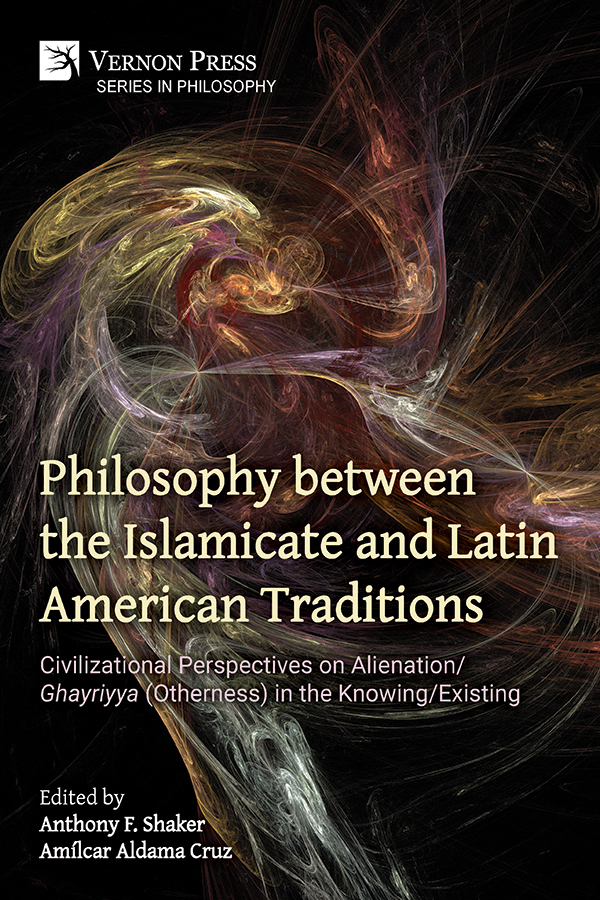
Philosophy between the Islamicate and Latin American Traditions
Civilizational Perspectives on Alienation/Ghayriyya (Otherness) in the Knowing/Existing
Anthony F. Shaker, Amílcar Aldama Cruz (Eds.)
by Anthony F. Shaker, Amílcar Aldama Cruz (Havana University, Cuba; Al-Mustafa International University, Iran; “Dr. Osvaldo A. Machado Mouret” Center for Arab and Persian Islamic Studies, Argentina), Hilal Oytun Altun (Jagiellonian University, Krakow, Poland), Hamidreza Ayatollahy (Allameh Tabatabaei University, Tehran, Iran), José Antonio Antón Pacheco (University of Sevilla, Spain), Luce López-Baralt (University of Puerto Rico, San Juan, Puerto Rico), Ángel Horacio Molina (Centro de Estudios Islámicos Árabes y Persas Dr. Osvaldo A. Machado Mouret, Argentina), James Maffie (University of Maryland), Omneya Ayad (Uskudar University, Istanbul, Türkiye), Mahdi Saatchi (Shahid Motahari University, Tehran, Iran), Hamedeh Rastaei (Aletaha Institute of Higher Education, Tehran, Iran)
Four cardinal points, long studied in isolation, now come together in a single journey, opening a shared horizon where two traditions reflect on indispensable concepts of existence.
Dr. Gonzalo Díaz Ponce
This book explores an intense approach for the dialogue across cultural boundaries in philosophy by scholars around the globe beyond “Western” dominance. First time Islamicate and the Latin America philosophical traditions get into conversation to remind us of the historical links and furthermore take steps towards deepening a common approach to their mutual knowledge that has significance to humankind.
Dr. Kadir Filiz
Philosophy Department
Marmara University, Istanbul
Latin America is a diverse mosaic of cultures that trace their origins back to Indigenous, African, Spanish, Portuguese and Islamic sources. Its philosophies, eloquently expressed by a long line of thinkers, are found not just in departments of philosophy, but also in its rich literature and art, which are given treatment in this volume.
The Islamicate world is a unique, fourteen-century-old cultural mosaic that covers much of the known world. Despite its long civilizational experience, it too faces the challenge of emancipation from foreign domination and the chaotic cacophony of monologues afflicting our time.
The papers collected here cover various aspects of the philosophies of these two constantly interacting traditions and how they impinge on an old problematic: “ghayriyya” (otherness) and “alienation”. Their themes include key figures like Ibn ʿArabī, Suhrawardī, Aḥmad b. Muṣṭafa al-ʿAlawī, Rudolfo Kusch, José Martí, Spain’s Moriscos, and contemporary Argentine philosophers; and expanding areas of research like the philosophy of the Nahua (popularly known as the “Aztec”) and the language reforms in Türkiye, both of which provide excellent examples of cultural self-alienation.
Opening Statement
Amílcar Aldama Cruz
Universidad de la Habana
Introductory Address
Anthony F. Shaker
PART ONE: ALIENATION AND CULTURAL INTERSECTIONS IN THE EARLY MODERN PERIOD
Chapter 1
Rodolfo Kusch: Towards a Latin American Philosophy of Liberation of Being and from Alienated Self
Ángel Horacio Molina
Centro de Estudios Islámicos Árabes y Persas Dr. Osvaldo A. Machado Mouret
Chapter 2
“Feeling more powerful than the King of Persia, when attending a laughing dawn”: Ishrāqī Philosophy’s Imprint on José Martí’s Thought
Amílcar Aldama Cruz
Universidad de La Habana
Chapter 3
The Secret Literature of the Last Muslims of Spain
Luce López-Baralt
Universidad de Puerto Rico
Chapter 4
Spiritual Transformation in Some Argentine Philosophers (Ismael Quiles, Armando Asti Vera, Vicente Fatone, Francisco García Bazán): À Propos the Concept of Ḥikma
José Antonio Pacheco
Universidad de Sevila
Chapter 5
Nahua Philosophy in the Era of the Conquest
James Maffie
University of Maryland
PART TWO: “GHAYRIYYA” (OTHERNESS) BEYOND THE SEPARATION
Chapter 6
Insān (Human Being) and the Function of Ghayriyya (Otherness) in Philosophy
Anthony F. Shaker
Chapter 7
Aḥmad b. Muṣṭafa al-ʿAlawī and His Understanding of Divine Oneness
Omneya Ayad
Üsküdar University
Chapter 8
The Human Being as an Alien in the World: Suhrawardī and the Story of Al-Ghurba al-gharbiyya
Mahdi Saatchi
Shahīd Motahharī University
Chapter 9
From Unicity to Multiplicity with the “Other” in Ibn ʿArabī’s Intellectual System
Hamedeh Rastaei
Aletaha Institute of Higher Education
PART THREE: TWO CASES OF SELF-ALIENATION
Chapter 10
The Turkish Language Reform within Its Historical Context
Hilal Oytun Altun
Jagiellonian University
Chapter 11
Western Humanism and the Origin of Modern Man’s Incapacity and Confusion Concerning the Transcendence and Strength of Thought
Hamidreza Ayatollahy
Allameh Tabatabaei University
General Bibliography
About the Contributors
Anthony F. Shaker, a philosopher and a scholar of Islamicate and German philosophy, has written extensively in both fields, most recently 'Reintroducing Philosophy: Thinking as the Gathering of Civilization' (2021) and 'Modernity, Civilization and the Return to History' (2017). His two-volume English translation and critical Arabic edition of Ṣadr al-Dīn Qūnawī’s 'Iʿjāz al-bayān' (2025) were published in 2025, as were his translations of four books from Ghazālī’s 'Iḥyāʾ al-ʿulūm' over the years. In the late 1990s, he was elected to the Executive Council of the Canadian Parliament’s official opposition party, where he chaired two committees. He obtained his doctorate and master’s degrees from the Institute of Islamic Studies, McGill University.
Amilcar Aldama Cruz, a scholar of Islamic philosophy, is a faculty member at Al-Mustafa International University, Iran, where he has taught logic and Islamic philosophy since 2017. He has published several papers and books, including 'The Transcendental Philosophy of Mullā Sadrā and Lexicon of Islamic Philosophy' (forthcoming), and serves as Editor-in-Chief of 'Sadra: Journal of Islamic Philosophy' (Spanish). A doctoral candidate in philosophy at the University of Havana, he also holds a master’s degree in Islamic Studies at Al-Mustafa International University (2025).
Seville, Andalus, Spain, Islamic and Latin American worlds, Spanish history, Latin American literature, Analusian philosophy, otherness, alienation, Islamic philosophy, Hikma, ilm al-hikma, Marxist theory of alienation, Marxism, myth of the West, Westernism, Arielism
Rodolfo Kusch, Latin American thought, alienation, existential philosophy, indigenism
Martí, Iranian Poetry, Cuban Literature, Ralph Waldo Emerson, Suhravardi, Qutb al-Din Shirazi, Hafiz, Dashtaki, Goethe, Rumi, Umar Khayyam, Ferdowsi, Shams al-Din Shahrazuri, light metaphor, ishraq
Moriscoes, Andalus, Spanish Muslims, Muslims of Iberia, Muslim cultural in Spain, Andalusian literature, Spanish literature, Spanish history, North Africa, Maghrib, Cervante, Don Quixote
Hikma, Islamic philosophy, Falsafa, Ibn Arabi, Ibn Sina, Orientalism, Ismael Quiles, Armando Asti Vera, René Guénon, Vicente Fatone, Francisco García Bazán, García Bazán, María Zambrano, Buddhism, Hiduism
Nahua philosophy, Aztec philosophy, Nahua culture, Maya, Native Studies, Sahagún, comparative philosophy, Teotl
Otherness, alienation, Ibn Arabi, Qunawi, Mulla Sadra, Ibn Sina, Tilimsani, Islamic logic
Ahmad al-‘Alawi, Algerian Sufism, Ibn al-Farid
Suhrawardi, Occidental Exile, metaphysics of light, light metaphor, Platonic forms, philosophy of illumination, Suhrawardi’s allegories
Akbari philosophy, Irfan, unicity and multiplicity, one and many
Turkey, Turkiye, Turkish history, Ottoman history, Ottoman State, Ottoman language reforms, Turkish language reforms, Ottoman language, Turkish language, Turkey and Central Asia, Turkish thought, Turkish ethnicity, Atatürk, westernization, Tanzimat, Turkish republic
Humanism, Western subjectivism, Western intellectualism
Subjects
History
Philosophy
Series
Series in Philosophy
Related services
Find in a library near you Download HQ cover Find in Bookshop.orgSee also
Bibliographic Information
Book Title
Philosophy between the Islamicate and Latin American Traditions
Book Subtitle
Civilizational Perspectives on Alienation/Ghayriyya (Otherness) in the Knowing/Existing
ISBN
979-8-8819-0415-9
Edition
1st
Number of pages
286
Physical size
236mm x 160mm