
Search
Browse
by Publication status
by Subject
Anthropology (26) Art (171) Business and Finance (38) Cognitive Science and Psychology (63) Communication and Journalism (51) Economics (116) Education (71) History (169) Human Geography (23) Interdisciplinary (43) Language and Linguistics (178) Law (16) Music Studies (18) Philosophy (222) Political Science and International Relations (127) Sociology (404) Statistics and Quantitative Methods (21)by Series
Series in Literary Studies (62) Series in Philosophy (57) Series in Education (49) Series in Sociology (42) Series in World History (31) Series in Politics (30) Bridging Languages and Scholarship (26) Series in Language and Linguistics (25) Cognitive Science and Psychology (20) Series in Philosophy of Religion (20) Series in American History (19) Series in Art (19) Critical Perspectives on Social Science (16) Series in Cinema and Culture (16) Curating and Interpreting Culture (15) Series on the History of Art (14) Series in Anthropology (13) Series in Critical Media Studies (13) Economics (13) Series in Business and Finance (12) Series in Music (12) Series in Performing Arts (9) Philosophy of Personalism (8) Series in Communication (8) Series in Law (8) Series in Economic Methodology (7) Series on Climate Change and Society (7) Classics in Economics (6) Series in Economic Development (6) Women's Studies (6) Philosophy of Forgiveness (5) Series in Built Environment (5) Series in Economic History (5) Series in Philosophy of Science (4) Series in Social Equality and Justice (4) Series on the History of Science (4) Serie en Sociología (3) Series in Contemporary History (3) Series in Creative Writing Studies (3) Series in Design (3) The Interdisciplinary Built Environment (3) Series in Heritage Studies (2) Series in Innovation Studies (2) Serie en Ciencias Políticas (1) Serie en Comunicación y Medios (1) Serie en Entorno Construido (1) Serie en Estudios Culturales (1) Serie En Estudios Literarios (1) Serie en Filosofía (1) Serie en Música (1) Series in Classical Studies (1) Series in Economics of Technological Change (1) Series in Philosophy of Race (1) Series in Urban Studies (1)by Language
English Spanishby Author
Browsing with filters

Political Messaging in Music and Entertainment Spaces across the Globe. Volume 1.
Edited by
Uche Onyebadi
Availability: In stock
339pp. ¦ $86 £67 €74
'Political Messaging in Music and Entertainment Spaces across the Globe' uniquely expands the frontiers of political communication by simultaneously focusing on content (political messaging) and platform (music and entertainment). As a compendium of valuable research work, it provides rich insights into the construction of political messages and their dissemination outside of the traditional and mainstream structural, process and behavioral research focus in the discipline. Researchers, teachers, students and other interested parties in political communication, political science, journalism and mass communication, sociology, music, languages, linguistics and the performing arts, communication studies, law and history, will find this book refreshingly handy in their inquiry. Furthermore, this book was conceptualized from a globalist purview and offers readers practical insights into how political messaging through music and entertainment spaces actually work across nation-states, regions and continents. Its authenticity is also further enhanced by the fact that most chapter contributors are scholars who are natives of their areas of study, and who painstakingly situate their work in appropriate historical contexts.
Classical Music in a Changing World (Audio CD Edition)
Crisis and Vital Signs
Edited by
Lawrence Kramer, Fordham University
and Alberto Nones, Conservatory of Music of Gallarate; Associazione Europea di Musica e Comunicazione (AEMC), Italy
Availability: Available 4 weeks
116pp. ¦ $52 £39 €44
In recent years classical music has become a test case for debates over the future of culture. As times have changed, the value traditionally placed on this music has been challenged on social rather than aesthetic grounds. Lovers of classical music have been asked how its privileged history can be reconciled with growing demands for social justice and social inclusiveness. They have been asked how the music’s standing as one of the great accomplishments of the West can be reconciled with the many injustices on which those accomplishments in part depended. How can the future of classical music escape the darker shadows of its past? ‘Classical Music in a Changing World: Crisis and Vital Signs’ addresses the crisis provoked by such questions in two complementary ways. Several of the chapters show how the classical music world is already grappling with the crisis, and finding vital signs beyond the borders of the music’s traditional European strongholds: in Turkey from Ottoman times to the present, in Colombia, and in a Black American film. Other chapters identify areas that still need improvement, especially on behalf of female and LGBTQ+ musicians, and suggest how advances can be made both on concert stages and in schools. This volume, which opens with an introduction by Alberto Nones that contextualizes the book and outlines the main arguments of its chapters, contains an essay by Lawrence Kramer that examines the place of classical music in the history of consciousness—a history now changing rapidly—and concludes with a Postscript written by the two editors. The writing in this volume will be accessible to a wide audience, including scholars and students, professionals and amateurs, performers and listeners. Teachers will find it a source of lively classroom debate, and scholars a source of learning outside the usual arenas. The book’s “vital signs” include the accompanying audio tracks (available for download at: https://vernonpress. com/book/1281), which feature vibrant music-making from a diverse range of performers and composers.
Classical Music in a Changing World
Crisis and Vital Signs
Edited by
Lawrence Kramer, Fordham University
and Alberto Nones, Conservatory of Music of Gallarate; Associazione Europea di Musica e Comunicazione (AEMC), Italy
Availability: In stock
116pp. ¦ $40 £30 €34
In recent years classical music has become a test case for debates over the future of culture. As times have changed, the value traditionally placed on this music has been challenged on social rather than aesthetic grounds. Lovers of classical music have been asked how its privileged history can be reconciled with growing demands for social justice and social inclusiveness. They have been asked how the music’s standing as one of the great accomplishments of the West can be reconciled with the many injustices on which those accomplishments in part depended. How can the future of classical music escape the darker shadows of its past? ‘Classical Music in a Changing World: Crisis and Vital Signs’ addresses the crisis provoked by such questions in two complementary ways. Several of the chapters show how the classical music world is already grappling with the crisis, and finding vital signs beyond the borders of the music’s traditional European strongholds: in Turkey from Ottoman times to the present, in Colombia, and in a Black American film. Other chapters identify areas that still need improvement, especially on behalf of female and LGBTQ+ musicians, and suggest how advances can be made both on concert stages and in schools. This volume, which opens with an introduction by Alberto Nones that contextualizes the book and outlines the main arguments of its chapters, contains an essay by Lawrence Kramer that examines the place of classical music in the history of consciousness—a history now changing rapidly—and concludes with a Postscript written by the two editors. The writing in this volume will be accessible to a wide audience, including scholars and students, professionals and amateurs, performers and listeners. Teachers will find it a source of lively classroom debate, and scholars a source of learning outside the usual arenas. The book’s “vital signs” include the accompanying audio tracks (available for download at: https://vernonpress. com/book/1281), which feature vibrant music-making from a diverse range of performers and composers.
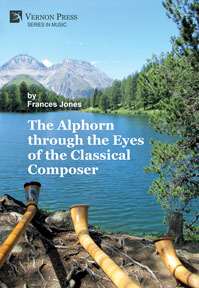
The Alphorn through the Eyes of the Classical Composer
October 2020 / ISBN: 978-1-64889-060-4Availability: In stock
336pp. [Color] ¦ $81 £60 €68
‘The Alphorn through the Eyes of the Classical Composer’ is the first and definitive book to be written about the alphorn in English. It has been written with English-speaking readers in mind, as it examines the extensive interest of primarily non-Swiss composers, writers and artists in the alphorn as a symbol of the Alps, the influence and significance of the alphorn in culture, literature and the arts across the globe, and the ways in which the instrument has been specifically utilised by the Swiss as the iconic representation of their country. This book also explores the use of the musical language of the alphorn call, to ascertain why and how such references as those of Berlioz or Beethoven can convey so much meaning. Dr Jones seeks out what it is that a composer brings into the concert hall, the theatre, the opera house, the church, or the drawing room by such a quotation, to what heritage they are referring, and upon what basis there are grounds for an assumption that such a reference will be understood by an audience. The book, which will be of interest to researchers in Swiss cultural studies and ethnomusicology, builds on Dr Jones’s research and PhD thesis. The six chapters deal with a variety of topics, including a basic introduction to the alphorn and an exploration of the promotion of the instrument as the symbol of Switzerland, as well as the reasons behind symbolic references to alphorn motifs by European and British composers in concert repertoire, jazz and film.
The Condition of Music and Anglophone Influences in the Poetry of Shao Xunmei
Tian Jin, University of Edinburgh
Availability: In stock
176pp. ¦ $49 £37 €42
This book examines the unique poetics of Shao Xunmei 邵洵美 (1906-1968), a Chinese poet who has long been marginalized by contemporary criticism. Shao aspires to reach the condition of music in poetry, which bears a resemblance to three Anglophone writers whom he applauds: Algernon Charles Swinburne, Edith Sitwell, and George Augustus Moore. The Condition of Music and Anglophone Influences in the Poetry of Shao Xunmei investigates how these three writers influenced Shao, and how this inspiration helped shape his idea of the condition of music in poetry. In the scope of world literature, this book aims to fill a small but important puzzle piece in the global network of literary influence. In a world where cultural exchanges have become increasingly frequent and convenient, and at a time when counter-globalization seems to burgeon into a hazardous trend, it is beneficial to look back to the 1920s-1930s, a time that is as equally tumultuous as today, to examine the global influence network that has taken us where we are, and to understand that in the dynamic of literary influence, no single piece of literature can have its significance alone. This groundbreaking book will benefit the scholarship of Shao and contribute to the relevant research in Chinese studies and word and music studies. Therefore, it will be of great use and interest to researchers of comparative literature, Chinese literature, and world literature, as well as scholars of word and music studies.