Loading...
Please wait while we load the content...

Loading...
Please wait while we load the content...
Loading...
Please wait while we load the content...
Explore peer - reviewed titles across the humanities and social sciences - rigorous research, fresh perspectives, and scholarship that inspires dialogue across disciplines.
Stay informed about our latest publications, calls for proposals, author news, events, and special announcements.
Join our community of scholars, librarians, authors, and readers and receive the latest updates from Vernon Press directly in your inbox.

From special discounts and global distribution partners to downloadable catalogs, flyers, and high-resolution covers, we make it easy to enrich your library’s collection. Access bibliographic data, explore subject-specific listings, and stay updated on forthcoming titles.
Become part of our librarian network and access dedicated tools, discounts, and resources to support collection development and promote new titles to your patrons.

Partner with Vernon Press to provide your customers with high-quality, peer-reviewed scholarship. We offer flexible ordering options, reseller agreements, and promotional materials to support your sales and outreach.

Vernon Press provides dedicated resources to help instructors adopt our books for courses and to support students with affordable access to high-quality scholarship. From desk and examination copies to tailored student editions, we aim to make our titles accessible in the classroom.

Space, Place, and Community in Action
Edited by: Meiqin Wang (California State University, Northridge)
This anthology elucidates the historical, global, and regional connections, as well as current manifestations, of socially engaged public art (SEPA) in East Asia. It covers case studies and theoretical inquiries on artistic practices from Hong Kong, Japan, mainland China, South Korea, and Taiwan with a focus on the period since the 2000s. It examines how public art has been employed by artists, curators, ordinary citizens, and grassroots organizations in the region to raise awareness of prevailing social problems, foster collaborations among people of varying backgrounds, establish alternative value systems and social relations, and stimulate action to advance changes in real life situations. It argues that through the endeavors of critically-minded art professionals, public art has become artivism as it ventures into an expanded field of transdisciplinary practices, a site of new possibilities where disparate domains such as aesthetics, sustainability, placemaking, social justice, and politics interact and where people work together to activate space, place, and community in a way that impacts the everyday lives of ordinary people. As the first book-length anthology on the thriving yet disparate scenes of SEPA in East Asia, it consists of eight chapters by eight authors who have well-grounded knowledge of a specific locality or localities in East Asia. In their analyses of ideas and actions, emerging from varying geographical, sociopolitical, and cultural circumstances in the region, most authors also engage with concepts and key publications from scholars which examine artistic practices striving for social intervention and public participation in different parts of the world. Although grounded in the realities of SEPA from East Asia, this book contributes to global conversations and debates concerning the evolving relationship between public art, civic politics, and society at large.

Edited by: Adrià Harillo Pla (Shanghai Jiao Tong University, China)
The title of this book is intended to be an honest one, far from exaggerated phrases and empty meanings. Three words, a preposition, and a coordinating conjunction: ‘Topics on Art and Money’. A coordinating conjunction, not a subordinating one, since this book does not intend to express a hierarchical order. As all words united by a coordinating conjunction, this book intends to connect them. As simple as that. This book presents, through the chapters written by its authors, some of the ways in which Art and Money are linked. In order to observe this relationship, this book consists of authors whose analysis refers to political propaganda, historical events with artistic repercussions or strictly economic analysis of the art market, for example. “And” connects, “or” divides. This book not only presents a connection between Art and Money, but between academics from different fields and geographical areas. This humble book presents, precisely, how individuals from different specialties think of this relationship. It will appeal to academics dedicated to Arts Economics and Cultural Management, professionals from the art market/world with an interest in works of an academic nature, and general readers with an interest in this topic and a strong knowledge of Arts Economics.
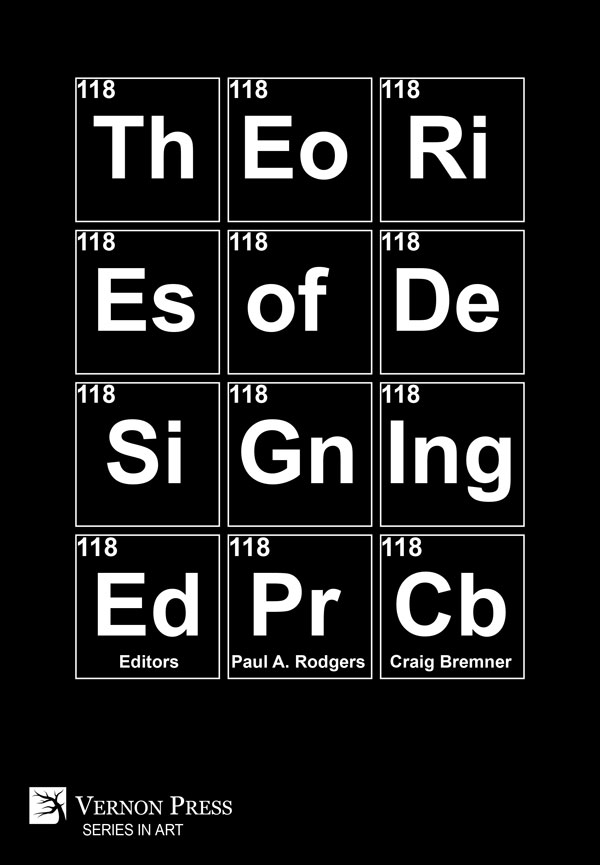
Edited by: Paul A. Rodgers (University of Strathclyde, UK) and Craig Bremner (Charles Sturt University, Australia)
Theories normally seek to explain something. 118 Theories of Design[ing] asks us to question those explanations. By focusing on a broad range of somewhat overlooked and undervalued essays, papers, book articles, words, terms, authors and phenomena that swirl around design[ing], the reader is encouraged to read, reflect and question everything. This original book will appeal to a global market of university faculty heads and deans, museum directors, design educators, design researchers, key design practitioners, publishers, members of the design media, and undergraduate, postgraduate and post-doctoral students of design.
Edited by: Ailsa Cox (Edge Hill University), James Hewison (Edge Hill University), Michelle Man (Edge Hill University), and Roger Shannon (Edge Hill University)
The English born artist and writer Leonora Carrington (1917–2011) has received much critical acclaim and achieved stellar status in Mexico, where she lived and worked for most of her life, having fled Europe via Spain in tormenting circumstances. Leonora Carrington: Living Legacies brings together a collection of chapters that constitute a range of artistic, scholarly and creative responses to the realm of Carrington emphasizing how her work becomes a medium, a milieu, and a provocation for new thinking, being and imagining in the world. The diversity of contributions from scholars, early career researchers, and artists, include unpublished papers, interviews, creative provocations, and writing from practice-led interventions. Collectively they explore, question, and enable new ways of thinking with Carrington’s legacy. Wishing to expand on recent important scholarly publications by established Carrington researchers which have brought historical and international significance to the artist’s legacy, this volume offers new perspectives on the artist’s relevance in feminist thinking and artistic methodologies. Conscious of Carrington’s reluctance to engage in critical analysis of her artwork we have approached this scholarly task through a lens of give and return that the artist herself musingly articulates in her 1965 mock-manifesto Jezzamathatics: “I was decubing the root of a Hyperbollick Symposium … when the latent metamorphosis blurted the great unexpected shriek into something between a squeak and a smile. IT GAVE, so to speak, in order to return.” (Aberth, 2010:149). In adopting her playful conjecture, this publication seeks to bring Carrington and her work to further prominence.
Edited by: Mary Sherman (MFA New York University)
This book is a compilation of papers derived from talks, presented at TransCultural Exchange’s 2018 International Conference on Opportunities in the Arts. The aim of these talks was to inspire artists to think across disciplines and cultures and to suggest other career models beyond the typical studio to gallery/museum model. Much of this content is unique in that it not only addresses the practical needs of artists but, even more importantly, it does so in the context of today’s global reality. As artists have noted on post-Conference surveys, this information is “the missing link in the art world; the bridge between academic and real-world practice; between a local and international career in the arts.” By making this information available long-after the Conference’s end and to those who could not directly participate in the Conference, many more artists will have access to where to find jobs/residency programs and funding for their work, information on how to put together successful residency applications, how to market their work, and other professional development programming. In addition, they (and interested members of the public) will have access to the Conference talks on what leading artists are doing across disciplines, with new technologies, and in the public sphere.
The invisible sources of the artwork: talks with today’s artists
By: Emma Coccioli
Romanticism, the brooding and intensely personal eighteenth-century art and literary movement, takes on a new lease of life in this carefully curated collection of interviews with contemporary artists from around the world. Informed by the writings of the renowned psychoanalyst James Hillman, Romanticism is reconsidered from a twenty-first-century perspective. Moving past a purely formal presentation of the artists’ work, this text strives to uncover the deeper meaning and more pressing issues present in the artworks. All connected by a similar romantic vein, Emma Coccioli explores each artist’s individual practice through a series of carefully selected questions. For Coccioli, discussions of ‘the moral issue’ and the future of the world also form an important part of the interviews. Coccioli acknowledges that artists have often been asked questions about their role in relation to the moral issue and the problem of nihilism. However, even if we have an inherent understanding of the concepts of good and evil, Coccioli argues that there is a need to re-examine the modern-day psyche as it tends to be apathetic and with little emotional resonance on our actions and behaviour. Global overpopulation, climate change, and the planet’s limited resources are also meaningfully discussed in this collection of interviews. In questioning the artists, whose work addresses, even remotely, these topics, Coccioli encourages them to consider what they believe to be the greatest threats to today’s global community and to suggest solutions that might be adopted by future generations. This original and engaging look at contemporary art practice presents a sophisticated discussion of some of the most pressing issues for modern-day society. The interdisciplinary nature of this book means that it will appeal to students, scholars, artists and to anyone with an interest in the fascinating world of contemporary art.
Edited by: Peter Swirski (University of Alberta, Canada) and Tero Eljas Vanhanen (University of Helsinki, Finland)
Artertainment is more than a novel aesthetic term reflecting the fact that art and entertainment have cross-pollinated each other throughout history. It is a creative strategy that purposely intertwines highbrow and lowbrow aesthetics in the name of reaching the connoisseurs and the masses. The Art of Artertainment sets out to unravel the jumble of aesthetic faultlines and prejudices found wherever we find artistic crossovers—which is to say, everywhere. Revisionist, iconoclastic, and artertaining in its own right, it provides a new framework for the analysis of American nobrow culture from the Colonial times to the digitally turbocharged present.
Edited by: Julie Reiss (Christie’s Education, New York)
Art, Theory and Practice in the Anthropocene contributes to the growing literature on artistic responses to global climate change and its consequences. Designed to include multiple perspectives, it contains essays by thirteen art historians, art critics, curators, artists and educators, and offers different frameworks for talking about visual representation and the current environmental crisis. The anthology models a range of methodological approaches drawn from different disciplines, and contributes to an understanding of how artists and those writing about art construct narratives around the environment. The book is illustrated with examples of art by nearly thirty different contemporary artists.